Smart Bulb Wattage Equivalent Calculator
Convert incandescent watts to smart LED wattage by target lumens, efficacy, color temperature, dimming headroom, bulb count, fixture cap, daily use, and heat output.
Smart LED Equivalent Results
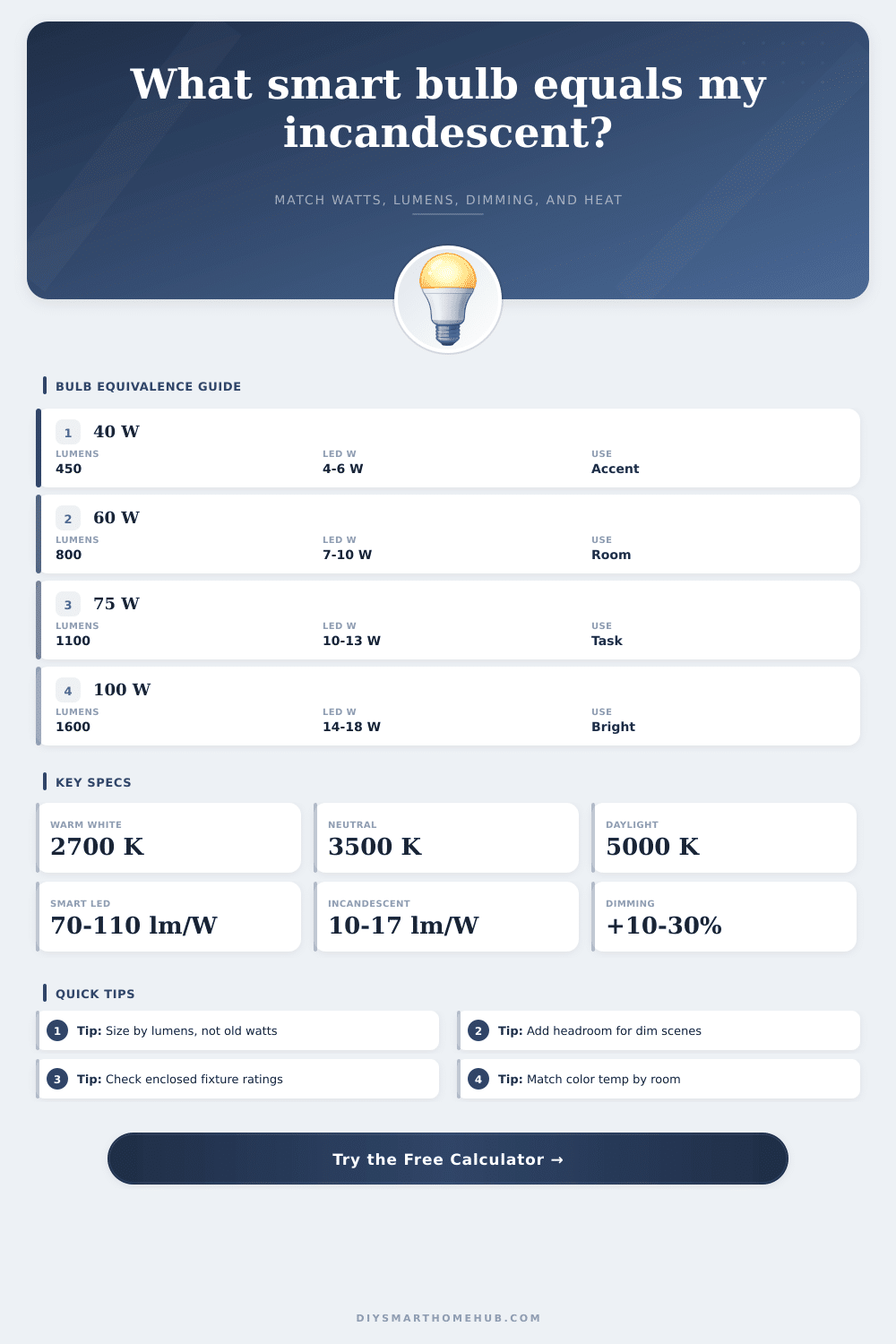
Common Incandescent to Smart LED Equivalents
| Incandescent Lamp | Typical Lumens | Smart LED Range | Best Match Notes |
|---|---|---|---|
| 25 W incandescent | 200 to 300 lm | 2 to 4 W | Accent lamps, nightstands, low-glare scenes |
| 40 W incandescent | 400 to 500 lm | 4 to 6 W | Table lamps, small sconces, decorative globes |
| 60 W incandescent | 750 to 850 lm | 7 to 10 W | Most A19 lamp replacements and general room light |
| 75 W incandescent | 1050 to 1150 lm | 10 to 13 W | Task fixtures, bright bedrooms, tall floor lamps |
| 100 W incandescent | 1500 to 1700 lm | 14 to 18 W | Garages, utility rooms, high-output smart bulbs |
Smart Bulb Type Comparison
| Smart Bulb Type | Efficacy Band | Typical Output | Recommendation |
|---|---|---|---|
| Warm A19 smart bulb | 80 to 105 lm/W | 800 lm | Best default for lamps and ceiling sockets |
| Tunable white A19 | 75 to 100 lm/W | 800 to 1100 lm | Good when scenes move from warm to daylight |
| RGB color A19 | 60 to 85 lm/W | 800 lm white mode | Add more headroom when saturated color is used |
| E12 candle smart bulb | 55 to 80 lm/W | 350 to 550 lm | Use more bulbs for chandeliers and vanity bars |
| BR30 recessed smart bulb | 65 to 90 lm/W | 650 to 1100 lm | Check beam spread and recessed can rating |
| High-output smart bulb | 85 to 120 lm/W | 1500 to 2600 lm | Useful for 100 W incandescent replacements |
Color Temperature Matching Guide
| Color Temp | Visual Feel | Incandescent Match | Common Smart Use |
|---|---|---|---|
| 2200 to 2700 K | Very warm | Closest to dimmed incandescent | Bedside lamps, evening scenes, dining |
| 2700 to 3000 K | Warm white | Closest to standard household bulbs | Living rooms, bedrooms, hallways |
| 3500 to 4000 K | Neutral white | Cleaner than incandescent | Kitchens, baths, laundry, task areas |
| 5000 to 6500 K | Daylight | Not an incandescent color match | Garage, workshop, utility, detail tasks |
Common Fixture Scenarios
| Fixture Scenario | Total Lumens | Bulb Count | Smart LED Planning Note |
|---|---|---|---|
| Single bedside lamp | 450 to 800 lm | 1 bulb | Choose warm white and add dimming headroom |
| Ceiling dome fixture | 1600 to 2200 lm | 2 bulbs | Divide lumens evenly and check enclosed rating |
| Bathroom vanity bar | 1800 to 3200 lm | 3 to 5 bulbs | Use neutral white and high CRI if available |
| Dining chandelier | 2000 to 3500 lm | 4 to 6 bulbs | Lower per-bulb output can still sum to bright light |
| Garage or utility socket | 1500 to 2600 lm | 1 to 2 bulbs | Favor high-output bulbs and confirm temperature limits |
So swapping out those old incandescents for some smart LEDs should be easy, right? Now you know that the watts printed on package don’t represent the same thing they did before. So instead of grabbing an equal 60-watt LED, you pick up one that’s only nine watts. Screw in the bulb and notice that the lamp isn’t quite as bright as you recall. Here’s the catch: Watts are about how much power something use; it’s not about light output.
This is important for smart bulbs which need to support color temperature changes and subtle dimming. You can plug those fixtures’ parameters, along with desired lumens, into above calculator. And it’ll do the rest of the calculation, saving you from having to guess if this bulb or that will be sufficiently bright.
How to Pick the Right LED Bulb
Since most of us were taught for decades that “light” was measured in watts, we continue thinking that way. The 100-watt bulb was bright, and the 40-watt bulb glowed softly. With today’s moddern technology, that mental short cut falls flat. That 8-9 watt LED may emit exactly as much light as that old-style 100-watt bulb did. But you’re not sacrificing anything in terms of light level. You’re simply preventing the wasting of electricity that becomes heat.
It is a small detail, but it is important when you want atmosphere different than a cooked lamp shade. So why are so many people getting it wrong? Because they’re looking at watts instead of lumens (the most popular error). If you replaced a sixty-watt incandescent with something that gave off approximately eight-hundred lumens, look for a similarly rated LED; around that same lumen output. The fact that it uses less energy is actualy a big plus.
Regardless, you will want to enter the exact efficacy rate (lumens/watt) into the calculator. That way you won’t undersize your lighting fixture. Dimmable smart bulbs tends to be less efficient than regular LEDs. After all, there’s some extra electronics in them besides just emitting light. A tunable white smart bulb may give off fewer lumens per watt then a simple warm-white model. So be sure to include that.
Another surprise is dimming headroom. Telling a smart bulb to be 50-percent bright doesn’t necessarily mean it will seem half-bright. The human eye perceives dimming logarithmically, not linearly. That means you may need to begin with a slightly brighter-than-target bulb if you want the setting to look comfortable when it’s dimmed down. You’ll still want headroom to lower it again without making the room dark. Pro lighting designers accounts for variable settings. Adding headroom as a percentage accomplishes this and mimics what lighting pros do.
One good reason to convert to LEDs is that they produce less heat. Traditional bulbs waste roughly 90% of the power they consume as heat, which means more heat in your confined light fixtures, adding extra strain to your air conditioner. LEDs run significantly cooler; they stay relatively cool. Not only does this extend the life of your LED it also prevents heat damage to your socket over time. The calculator will show you the reduced thermal load the LED fixture removes, particularly useful if you have enclosed fixtures like dome lights or recessed lighting. Heat buildup can kill these bulb in months instead of years.
Brightness has another component: color temperature. At the same lumen output, a cool 5000-kelvin daylight bulb can feel blaring and unpleasant compared to a warmer, softer 2700 Kelvin (two-seventy) bulb. Your brain perceives different colors of light; it registers blue as harsher. Use color-temperature to your advantage to make the light feel right. That means matching it to what the space is used for. Not enough brightness isn’t the only issue. The page’s reference table breaks it down into which kelvins match common applications. So you don’t go ahead and use super-white light in your comfy bedroom, for example, or too-warm light in your bright kitchen.
In the end, it’s not so much a matter of replacing one number with another but of replacing one intention with another. Meaning: The light should of serve the purpose of what you do in that room. It could be for cooking, reading, or just relaxing in there. Take into account fixture limits, your need for dimming, and lumen counts. A basic hardware change becomes an actual upgrade. It increases both your comfort and your efficiency.
It isn’t just about changing a bulb. It’s about providing better light while reducing heat and energy waste.