Outlet Device Load Calculator
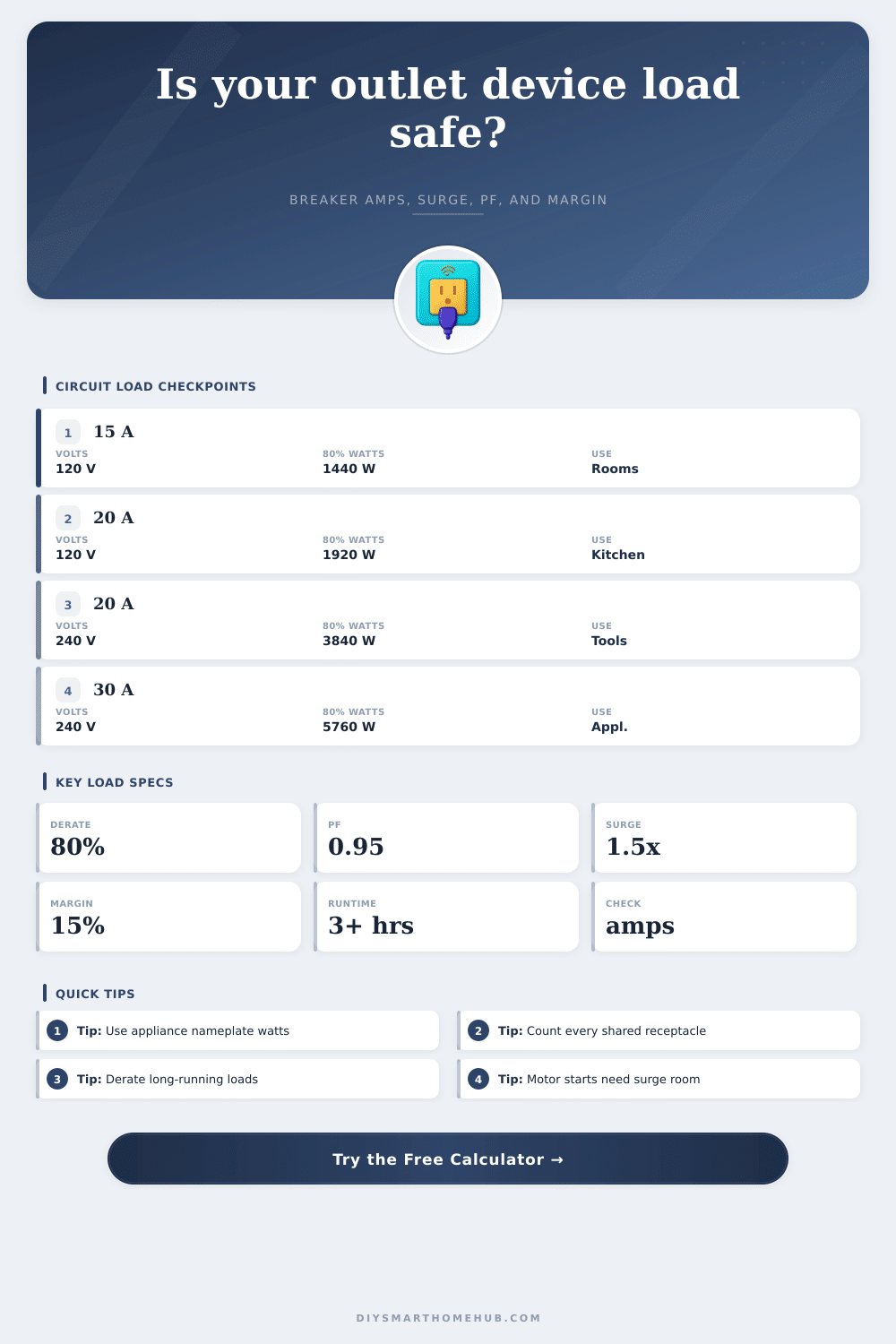
Check an outlet or shared branch circuit by combining volts, breaker amps, continuous-load derating, appliance watts, power factor, startup surge, receptacle count, and safety margin.
🔌Outlet load presets
⚙Circuit and device inputs
Calculation breakdown
📊Outlet load spec grid
Useful planning checkpoint for many general room receptacle circuits.
Common continuous-load target for kitchen, garage, and utility branches.
Modern power supplies often run near this range, but labels are better.
Compressors, pumps, vacuums, and shop tools can briefly draw much more.
📋Breaker and outlet capacity table
| Circuit rating | Voltage | Breaker VA | 80% continuous watts at PF 1.0 | Typical outlet use |
|---|---|---|---|---|
| 15 A general branch | 120 V | 1,800 VA | 1,440 W | Bedrooms, offices, living rooms, low-power smart gear |
| 20 A appliance branch | 120 V | 2,400 VA | 1,920 W | Kitchen counters, garage receptacles, laundry utility loads |
| 15 A dedicated branch | 240 V | 3,600 VA | 2,880 W | Small 240V tool or appliance with matching receptacle rating |
| 20 A dedicated branch | 240 V | 4,800 VA | 3,840 W | Workshop or equipment branch sized to the connected load |
| 30 A equipment branch | 240 V | 7,200 VA | 5,760 W | Larger dedicated appliance or equipment receptacle |
⚡Power factor and startup surge table
| Device type | Power factor range | Startup multiplier | Load planning note |
|---|---|---|---|
| Resistive heater, kettle, toaster | 0.98 to 1.00 | 1.00x | Running watts usually set the circuit load |
| Computer, TV, AV electronics | 0.90 to 0.99 | 1.05x to 1.30x | Many small power supplies can add up on one strip |
| LED driver or smart lighting supply | 0.85 to 0.98 | 1.05x to 1.20x | Power factor matters when many drivers share a circuit |
| Refrigerator, freezer, compressor | 0.75 to 0.90 | 2.0x to 3.5x | Startup can trip a circuit that looks fine by running watts |
| Shop vac, pump, small motor tool | 0.70 to 0.88 | 2.0x to 4.0x | Check surge current when other receptacles are already loaded |
🏠Common outlet load scenarios
| Scenario | Circuit assumption | Main device load | Shared load | Planning signal |
|---|---|---|---|---|
| Office desk circuit | 15 A at 120 V | 320 W electronics | 400 W | Usually comfortable unless a heater is added |
| Media wall receptacles | 15 A at 120 V | 650 W AV stack | 180 W | Check plug strips and always-on electronics |
| Kitchen appliance branch | 20 A at 120 V | 1,200 W appliance | 250 W | Short runs may fit, long runs need derating |
| Garage tool outlet | 20 A at 120 V | 1,200 W motor | 300 W | Startup surge may be the limiting factor |
| Network closet UPS | 15 A at 120 V | 520 W equipment | 120 W | Treat 24-hour electronics as continuous load |
🔧Formula reference table
| Check | Formula | Good result | Caution result |
|---|---|---|---|
| Base circuit capacity | Volts x breaker amps x power factor | Known breaker and voltage values | Wrong voltage or assumed PF hides current |
| Continuous load target | Base capacity x derating percent | Long-running load stays under target | 3-hour loads exceed the derated value |
| Running circuit amps | Total running watts / (volts x PF) | Below derated amp target | Near breaker rating after shared loads |
| Startup peak amps | Surge watts / (volts x PF) | Below breaker amps with margin | Motor start may trip the breaker |
| Remaining headroom | Safe watts - planned running watts | Positive margin remains | Negative value means the plan is overloaded |
💡Load calculation tips
Breaker trips at most inopportune moments because you treat your electrical outlets as an unlimited source of power. The problem isn’t necessarily one of overall capacity; it’s one of consumption. Things you don’t even consider contributing may be adding up to more than meets the eye. Phone chargers and a laptop draw no attention on a typical bedroom circuit. Add a vacuum cleaner or space heater and the numbers changes immediately. Find out what’s behind drywall before something trips.
What it does: The calculator enters all those variables (breaker rating vs. It enters all those variables, like the breaker rating versus the device watts, and does the math for you so you don’t have to guess if you are in danger. Most homeowners gets tripped up by instantaneous vs. Sustained load. A continuous load occur when an appliance is used continuously for three hours or longer. Over time, the heat generated in wire increases, and electrical codes call for circuits sized conservatively for this. This means your wires might stay within temperature limits for a while, but they will eventually degrade or melt insulation if you ignore the derating factor. The heat doesn’t appear magically then; it simply continues to build up. You might have fine insulation for a few minutes, but then your wires will degrade insulation well before smoke ever happens. That is the quiet failure mode no one plans for.
Why Your Breaker Trips
There’s also another intangible variable called power factor which is more important than most people think. Because moddern electronics run off switching power supplies, they don’t pull current in perfect time with the rising and falling voltage waveforms. There is a bit of a phase shift between the two. This results in you drawing far more apparent power from grid yet only doing 100 watts of real work. To account for this, the tool includes realistic power factor estimates in its safe capacity calculations, so what you calculate is actualy how much it will heat up the wires vs some idealized textbook scenario. Most smaller electronics these days is pretty well designed and have a good efficiency rating. Poorly designed LED drivers or older devices can really drag that number down though. In many residential applications, you aren’t paying for all that wasted reactive power directly. Instead, you’re paying with less headroom in the circuit (those extra amps still need to go somewhere, so they’re flowing through the wiring and breaker).
The danger zone is the startup surge. If you don’t pay attention, this is where startup surge gets dangerous. Appliances like shop vacs, refrigerator motors, and garbage disposals needs a short burst of electricity to start up. The duration of such a surge might be just a millisecond, too quick for most breakers to respond to under normal circumstances. But when the circuit is already maxed out (or close) from other devices, that surge tips the total current over the edge and your breaker trips open before a fire hazard occurs. To make something reliable, you need to calculate the sum of the combined steady running load plus these transient peak loads. On paper, a circuit may appear adequate by average wattage alone. In reality, the startup shock exceeds whatever is left of the margin and it doesn’t work.
Things get even more complicated when there are shared receptacle. The fact that a socket is located on a two-socket wall plate doesn’t necessarily mean it has dedicated capacity of its own. Most likely, both of those sockets is wired back to the same breaker. That breaker serves several other outlets in one or more rooms, which connect to even more outlets through lamps, chargers, and other devices. Every single device plugged into this loop count toward your total draw. Unless you physically verify otherwise, you need to presume that all of them can be running at once. This becomes especially bad for smart home gadgets, which sit plugged in and awake 24/7, and quietly chew away at whatever capacity remains without ever actualy giving you any instant feedback.
This one’s an oldie but a goodie: Frustration is avoided through planning. If you want to estimate how long something runs, include a margin of safety. Then, determine if you’ll need to move high-draw appliances onto separate circuits or even replace your service panel altogether. You should of planned ahead. The tool comes with handy reference tables that give you a quick standard for typical circuit configurations, which will help you visualize how your particular configuration compares to usual limits. Leave yourself some breathing room. For anticipated growth, or those unforeseen spikes, and you won’t be annoyingly resetting your breakers at inopportune times.