Laundry Room Lumens Calculator
Estimate laundry lighting from room size, washer and dryer zone, folding counter, utility sink, ceiling height, task lux, fixture output, diffuser loss, reflectance, and cabinet shadowing.
Laundry Lighting Result
| Zone | Typical lux | Footcandles | Calculator use |
|---|---|---|---|
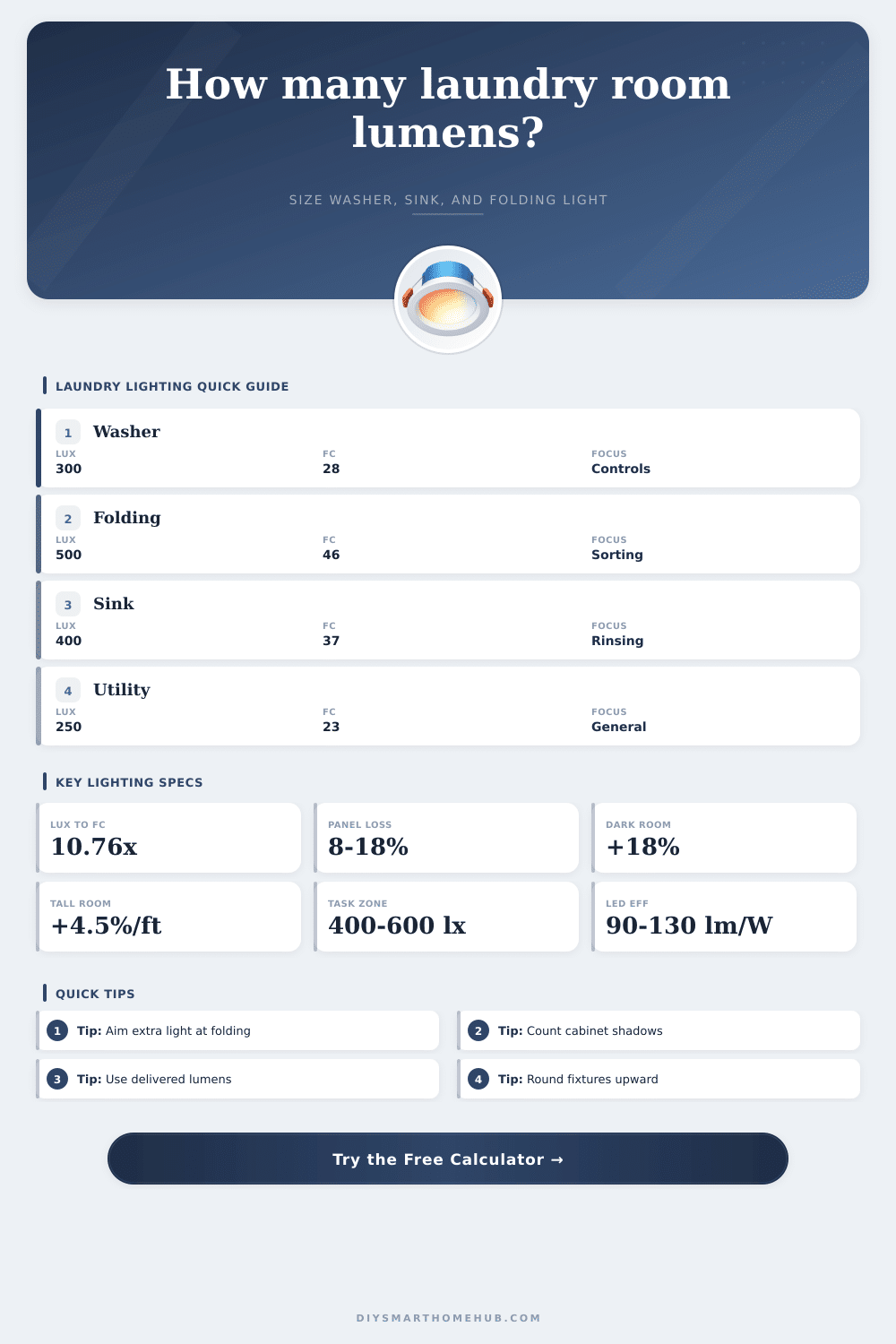
| General laundry circulation | 200 to 300 lx | 19 to 28 fc | Base room light for walking, loading baskets, and cabinet access. |
| Washer and dryer controls | 300 to 400 lx | 28 to 37 fc | Appliance labels, lint filter checks, and load sorting near machines. |
| Folding counter | 400 to 600 lx | 37 to 56 fc | The strongest task zone because stains, colors, and fabric edges matter. |
| Utility sink or stain station | 350 to 500 lx | 33 to 46 fc | Rinsing, soaking, and pre-treatment need light at the basin. |
| Basement utility laundry | 350 to 550 lx | 33 to 51 fc | Darker surfaces and open joists often increase fixture lumens. |
| Fixture type | Typical output | Diffuser loss | Best laundry fit |
|---|---|---|---|
| Flush-mount LED disk | 900 to 1600 lm | 8% to 16% | Compact rooms and low ceilings where wide, soft light is useful. |
| LED panel or flat wrap | 1800 to 4200 lm | 10% to 18% | Long galley laundry rooms, utility rooms, and basement spaces. |
| Recessed downlight | 650 to 1200 lm | 4% to 12% | Multiple fixtures over appliances and counters with controlled glare. |
| Linear under-cabinet bar | 300 to 900 lm | 0% to 8% | Folding counters shaded by wall cabinets or deep shelving. |
| Open shop-style strip | 3200 to 6000 lm | 0% to 8% | Garage and basement laundry where output matters more than concealment. |
| Condition | Model factor | Typical surface | Effect on lumens |
|---|---|---|---|
| Bright white laundry | 0.92 | White ceiling, pale walls, light doors | Reflects light well and slightly lowers fixture lumen demand. |
| Average light finishes | 1.00 | Light ceiling with mixed floor and appliances | Baseline factor for most laundry rooms. |
| Cabinets and medium tones | 1.08 | Upper cabinets, wood shelves, darker counter | Raises the target before cabinet shadow is added. |
| Concrete or exposed utility | 1.12 | Concrete walls, exposed joists, metal shelving | Needs more lumens to keep task zones readable. |
| Dark low-reflectance room | 1.18 | Dark paint, dark doors, black fixtures | Absorbs light and requires a larger fixture allowance. |
| Preset | Room area | Task bias | Planning signal |
|---|---|---|---|
| Laundry closet | 35 sq ft / 3.25 sq m | Washer controls | One bright fixture may work if the diffuser loss is modest. |
| Galley laundry | 66 sq ft / 6.13 sq m | Linear coverage | Spacing matters because a single central light can miss machine fronts. |
| Utility sink room | 90 sq ft / 8.36 sq m | Sink and counter | Extra task light near the basin keeps stain work visible. |
| Basement utility | 140 sq ft / 13.01 sq m | Dark surfaces | Reflectance and height factors usually drive fixture count upward. |
| Family laundry | 168 sq ft / 15.61 sq m | Multiple zones | Use several fixtures or a broad panel pattern for even task light. |
I’m sure there was a time you’ve been in a laundry room with your washer and dryer facing away from you trying to make out what’s on the washers control screen. Half the washer is in shadow, you’re tryin to make out tiny text. Why does this happen? Most of us thinks of laundry lights as mood lighting. We don’t think of it as work space; we need accuracy!
This is because a laundry room isn’t one space; it’s several spaces with unique tasks, some needing strong light (to see if those shirt collars is stained) and others requiring more general brightening (to load washers safely). To account for this, the tool asks you size of key areas… Washer zone, utility sink and folding counter, to separate these lighting needs. The logic here? A long galleried room commonly has light spread out across it, leaving dark nooks at appliances themselves. Defining the areas first creates light where it will get used.
How to Choose Laundry Room Lights
The calculator will do all calculations for you based off your zone definition. So no more wondering about coefficients and conversions. For example: the most challenging space in the room is the folding counter. Most people fails here. It’s easy to think that overall ambient light from ceiling is enough. However, you’re probably picking out clothing or rummaging through laundry… Which requires detailed work; and fabric colors and subtle stains vanishes without focused task lighting. This area receives a higher lux recommendation from the calculator, since it involve closer inspection of clothes to check for damage/pilling/etc.
Upper cabinets over your counter will gobble up your light budget very fast! So we account for cabinet shadowing in our input, and then our fixture count make up for the blockage. There are two other factors that determines the total: ceiling height and what color surfaces will be illuminated. The combination of concrete walls and exposed joists soaks up light quickly. Metal shelving and dark paint take even stronger fixtures to look as clear as lighter colors; both are sponges for light. To account for this, the model multiplies your lumen target if you choose darker finishes. You can think of it as a basic physics problem, but many people who buy off-the-shelf bulbs don’t consider the color of their walls and trip up.
There’s also an invisible variable: diffuser loss. Enclosed fixtures with frosted lenses conceal the bulb and look nice. But they decreases usable light output, sometimes by as much as 20%. Adjust this percentage in the calculator to reflect amount of actual light reaching your counter rather than just the amount exiting the bulb. If you don’t account for this, your room may be underlit, dim even though it has enough wattage on paper. A good chart is provided on page that spells it out in detail for various kinds of fixtures.
If you have recessed downlights, these can be placed strategically above counters and appliances with great results. For cabinet tasks, linear LED strip fixtures underneath are excellent for eliminating shadows on folding surfaces. For garage laundry spaces, which do not require aesthetic concealment as much as raw output, an open style shop fixture work well. Even though the lumen requirements may remain the same, what kind of fixture you select determines how many you should of required.
A little light goes a long way, it eliminates eye strain and makes what would otherwise be a chore manageable. You can’t hang half a light, so it rounds up to a whole fixture; so, you won’t end up short on light. And once you plug in your preferences and room dimensions, it shows you exactly how much light you’ll get. And stop guessing about if one fixture will do it or not in that dark closet laundry nook. Figure out the right amount of brightness before buying a single thing.
Then when you turn the lights on, the washer controls are clearly lit up, and the folding table glows brightly enough to pick apart each individual thread: well done, you’ve got the math down. And that sort of visibility makes even an otherwise plain, useful space a truly functional part of your home. So a little care with lumens goes a long way toward everyday comfortly.