Battery Series Voltage Calculator
Calculate a series string from cell voltage or battery-block voltage, including nominal voltage, full charge voltage, empty cutoff, charger target, BMS voltage limit, unchanged Ah, and total Wh.
Nominal series voltage
- -Full and charger voltage
- -Empty cutoff voltage
- -Ah and energy
- -Calculation breakdown
Blocks in series multiplied by cells inside each block.
Per-cell value multiplied by cells per block when using cell basis.
Use this for the high-voltage limit check.
Nominal series voltage multiplied by load current.
| Chemistry | Nominal per cell | Full per cell | Empty planning cutoff |
|---|---|---|---|
| Li-ion / NMC | 3.6 to 3.7 V | 4.20 V | 2.8 to 3.0 V |
| LiFePO4 | 3.20 V | 3.55 to 3.65 V | 2.5 to 2.9 V |
| Lead-acid | 2.00 V | 2.40 to 2.45 V | 1.75 to 1.85 V |
| NiMH | 1.20 V | 1.45 V | 1.00 V |
| Series string | Li-ion nominal / full | LiFePO4 nominal / full | Common planning note |
|---|---|---|---|
| 3S | 11.1 V / 12.6 V | 9.6 V / 10.95 V | Small UPS, controls, portable electronics |
| 4S | 14.8 V / 16.8 V | 12.8 V / 14.6 V | 12 V-class LFP and compact DC systems |
| 7S | 25.9 V / 29.4 V | 22.4 V / 25.55 V | 24 V-class packs and power tools |
| 13S | 48.1 V / 54.6 V | 41.6 V / 47.45 V | 48 V nominal Li-ion packs |
| 16S | 59.2 V / 67.2 V | 51.2 V / 58.4 V | 48 V-class LiFePO4 storage systems |
| Formula | What it answers | Series effect | Calculator output |
|---|---|---|---|
| Battery V = cell V x cells per block | Voltage of one battery or module | Uses the block before the series multiplier | Block nominal, full, and empty voltage |
| Pack V = battery V x series count | Total series string voltage | Voltage adds across the string | Nominal, full, empty, charger, BMS limit |
| Pack Ah = battery Ah | Capacity in amp-hours | Ah stays unchanged in series | Series Ah result card |
| Energy Wh = nominal pack V x Ah | Stored nameplate energy | Energy rises because voltage rises | Wh and usable Wh after reserve |
| Project size | Typical series layout | Nominal voltage | Charger / BMS check |
|---|---|---|---|
| Single IoT node | 1S or 2S Li-ion | 3.7 to 7.4 V | USB charger or 2S balance charger must match cell count |
| Router backup | 3S Li-ion or 4S LFP | 11.1 to 12.8 V | Use charger full voltage, not only nominal voltage |
| Garage DC bus | 7S Li-ion or 8S LFP | 25.6 to 29.6 V | Confirm inverter and DC load maximum voltage |
| Whole-home storage | 13S Li-ion or 16S LFP | 48.1 to 51.2 V | BMS, charger, breaker, and inverter voltage windows must align |
So you start off with some lithium cells and want them to drive a workbench in your garage. But as initial thrill wears off, it turns out connecting those cells isn’t just a matter of stacking voltages. There’s also the question of what your tools require; how much charge chemistry will take, and what your charger can deliver without damaging itself or the batteries.
That’s where the magic lies: knowing the difference between series (upping voltage but retaining the same number of available amp-hours) vs. Parallel adds amp-hours but does nothing for voltage. The full charge voltage is not the same thing as nominal voltage, which most builders mix up. The nominal voltage is just a handy average number used to name the system. A 12 volt battery rarely remain twelve volts long enough to get a proper measurement. Fresh batteries start high, drained ones goes lower.
How to Connect Lithium Cells Safely
After you choose your battery chemistry profile, the tool on the page will do the math for you. That’s the part where it saves you from having to guess whether to trust the label or charger manual. If you cannot handle the peak voltage of your battery, your equipment may be damage.
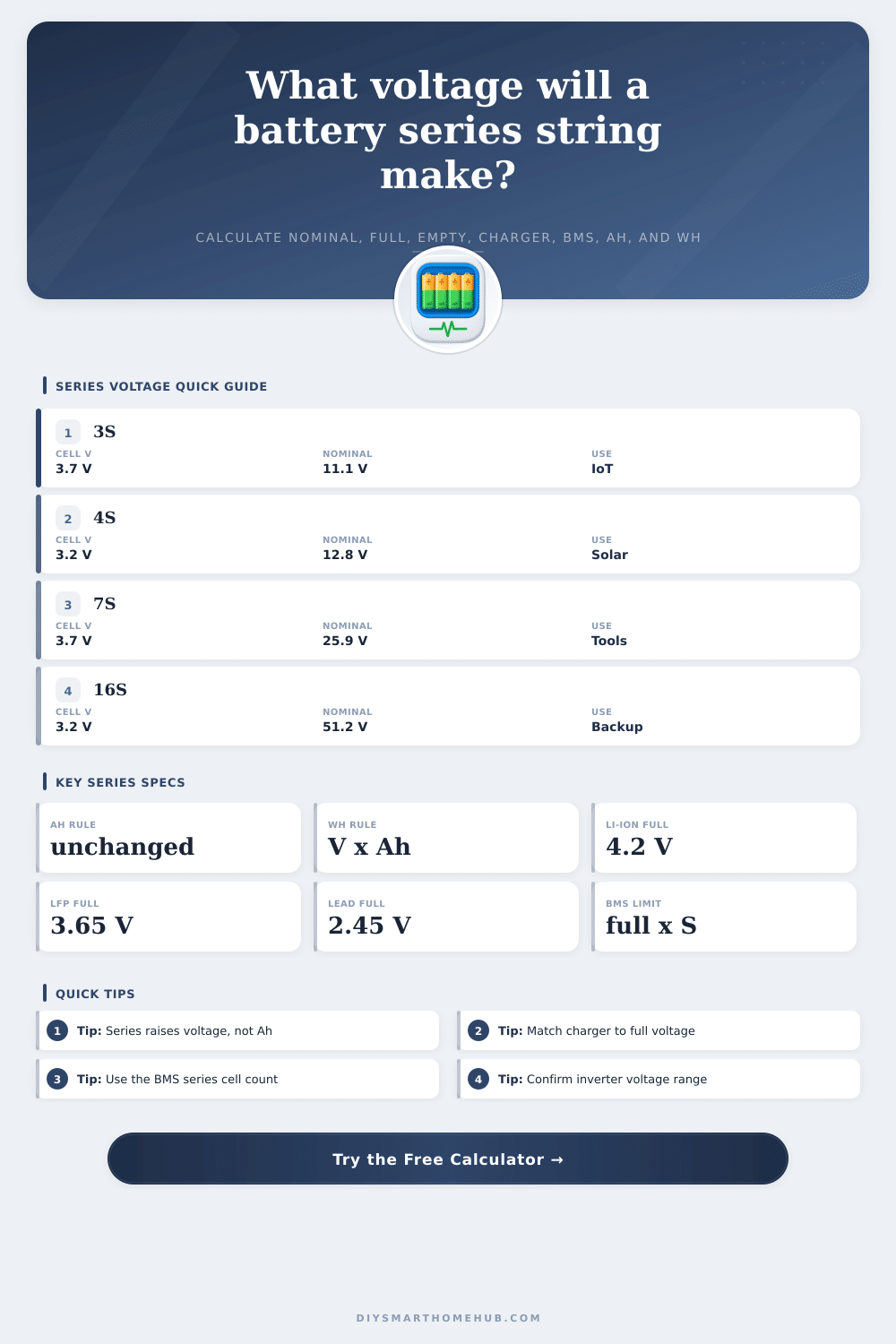
That changes once you add batteries, but should you use Li-ion or LiFePO4? Standard lithium ion is around 3.7 volts, but lithium iron phosphate are 3.2 volts. That small difference makes a big difference when you string together twenty or thirty cell. On the page, they have a reference table showing that if you make a sixteen-series string of LFP, it’s a fifty-one-volt system.
You need to present your inverter with a certain range (and your Battery Management System has hard limits). Nominal voltage only will get you wired up so it will probably brick your inverter and blow a fuse when the pack hit full charge. Regardless of the number of cells in series, the amp-hour rating doesn’t change. That’s where people go wrong most often. Adding voltage does not add capacity. A hundred-amp-hour pack is a hundred amp hours regardless of whether it operates on 48V or 12V.
The difference are how much energy it stores (in watt-hours). More volts gives you the same power but with lower current. Thinner wires mean lower heat generation. This is an efficiency tradeoff worth additional complexity of high-voltage systems.
When you’re done designing, think about what happens at end of life for every cell. That “empty” cutoff voltage isn’t a recommendation; it’s a danger zone. Go below it and either trigger a harsh shutdown by the BMS, or (worse) damage chemistry forever. Leave yourself some room for error, because when one cell reaches its low point, the whole system should of shut down before it drops below that line. It won’t compensate if you don’t balance with a circuit.
And also consider your load profile. A fridge pulls moderate current for hours and a drill pull big current for seconds. Both of these is fine with a high-voltage system because the drop in internal resistance is relatively smaller compared to overall system pressure.
Be sure to set charger to the FULL string voltage, not the nominal. If you have a sixteen series LFP pack, don’t set the charger to fourteen volts; it’ll always be undercharging. That’s why the system is designed that way.
Respect the margins: Respecting the margins is all about building a series string. Arithmetic is the job for the tools you are holding in your hands; feeling out an overloaded wire or an ever so slightly unbalanced cell are not. Plan for the peaks along with average, read the data, and respect the chemistry limits. Start at voltage targets and let the capacity fall where it may naturaly. Check the BMS limits and let the capacity fall into place. Getting the numbers right from the first cell to the last keeps the dream of self-powering gear alive.