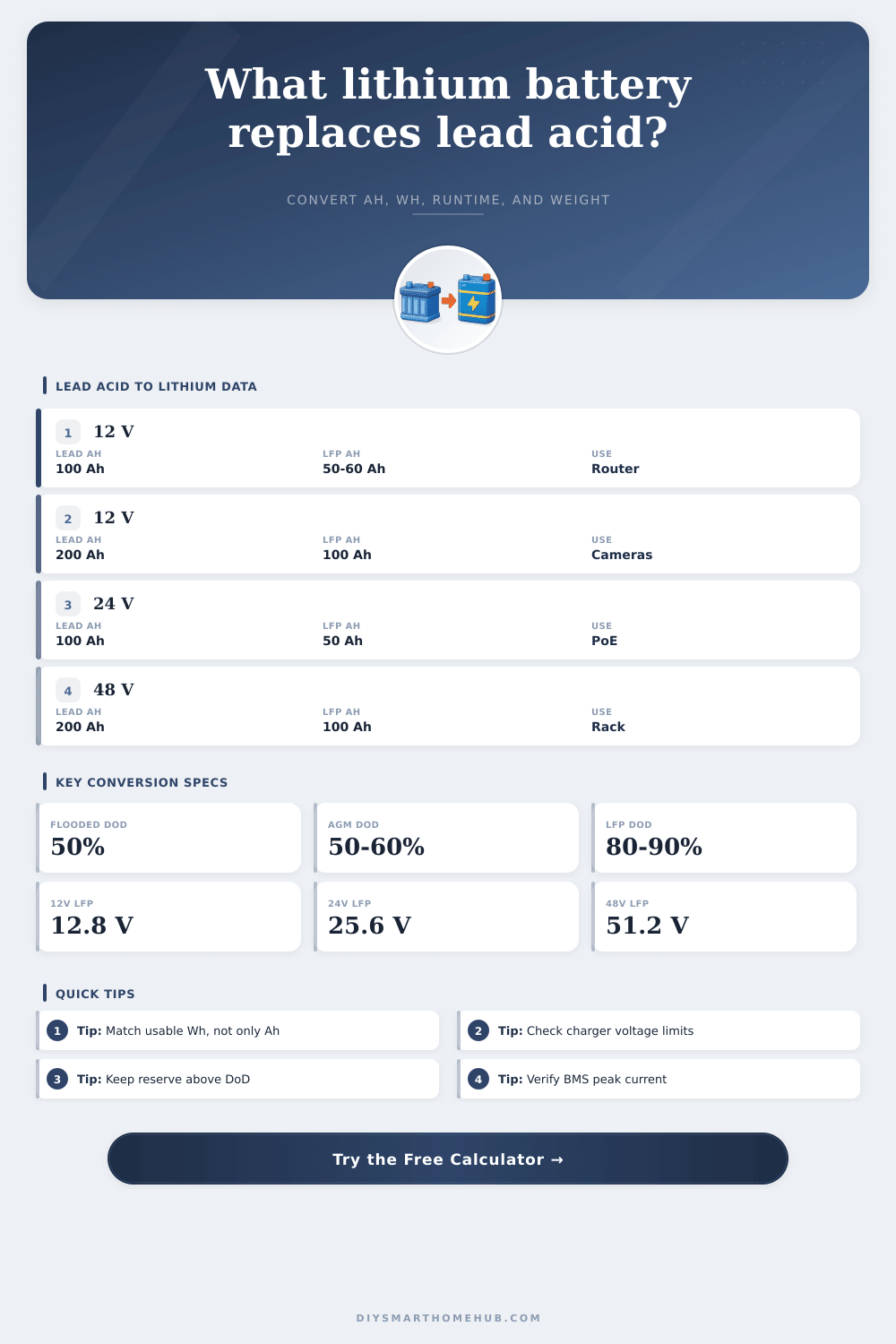
🔋 Lead Acid to Lithium Battery Conversion Calculator
Calculate the equivalent lithium battery capacity, weight savings, and runtime when converting from lead acid to LiFePO4 or other lithium chemistries.
| Battery Type | Rated Ah | Usable DoD | Usable Ah | Nominal Voltage | Usable Wh |
|---|---|---|---|---|---|
| Flooded Lead Acid | 100Ah | 50% | 50Ah | 12.0V | 600Wh |
| AGM Lead Acid | 100Ah | 60% | 60Ah | 12.0V | 720Wh |
| Gel Lead Acid | 100Ah | 80% | 80Ah | 12.0V | 960Wh |
| LiFePO4 | 100Ah | 90% | 90Ah | 12.8V | 1152Wh |
| NMC Lithium | 100Ah | 90% | 90Ah | 14.4V | 1296Wh |
| LiFePO4 (24V) | 100Ah | 90% | 90Ah | 25.6V | 2304Wh |
| LiFePO4 (48V) | 100Ah | 90% | 90Ah | 51.2V | 4608Wh |
| Capacity | Lead Acid Weight | LiFePO4 Weight | Weight Saved (lbs) | Weight Saved (kg) |
|---|---|---|---|---|
| 100Ah @ 12V | 60 lbs (27 kg) | 26 lbs (12 kg) | ~34 lbs | ~15 kg |
| 200Ah @ 12V | 120 lbs (54 kg) | 52 lbs (24 kg) | ~68 lbs | ~31 kg |
| 200Ah @ 24V | 240 lbs (109 kg) | 104 lbs (47 kg) | ~136 lbs | ~62 kg |
| 400Ah @ 12V | 240 lbs (109 kg) | 104 lbs (47 kg) | ~136 lbs | ~62 kg |
| 400Ah @ 48V | 960 lbs (435 kg) | 416 lbs (189 kg) | ~544 lbs | ~247 kg |
| Lead Acid Rated | LA Usable Ah | LiFePO4 Equiv. Ah | 30Ah/day Runtime (LA) | 30Ah/day Runtime (Li) |
|---|---|---|---|---|
| 100Ah | 50Ah | 56Ah | 1.7 days | 1.9 days |
| 200Ah | 100Ah | 112Ah | 3.3 days | 3.7 days |
| 300Ah | 150Ah | 167Ah | 5.0 days | 5.6 days |
| 400Ah | 200Ah | 223Ah | 6.7 days | 7.4 days |
| 600Ah | 300Ah | 334Ah | 10.0 days | 11.1 days |
When you replace lead acid batteries with lithium batteries, you have to understand the way that lead acid batteries and lithium batteries functions. Lead acid batteries has a limited depth of discharge. This means that you cannot use all of the energy that is stored within the lead acid battery.
If you discharge the lead acid battery to less than 50% of its capacity, it will reduce the lifespan of the lead acid battery. In contrast, lithium batteries, specificaly LiFePO4 batteries, have a higher depth of discharge. With lithium batteries, you can use up to 80 or 90% of the energy without damage the battery.
Why Lithium Batteries Are Better Than Lead Acid Batteries
Because there is more usable energy from a lithium battery, you can use a smaller lithium battery to supply the same amount of energy as a larger lead acid battery. When calculating the energy requirement for a facility or system, it is important to calculate the usable watt hours that are required instead of using the amp hours as an indicator. The amp hour is a deceptive number because it does not account for the depth of discharge that occur from the batteries.
A calculator will help to determine the usable watt hours that is needed for the facility. The calculator accounts for the fact that the lead acid batteries do not deliver there full capacity. By calculating the usable watt hours, you ensure that you dont select a lithium battery that is too large for the needs of the facility.
Another factor to consider is the voltage and the charging profile of the batteries. Both lithium batteries and lead acid batteries has different charge profiles. Lead acid batteries need to be floated to maintain their charge.
The charge profile that you use for lithium batteries is not the same than that for lead acid batteries. If you use a charger with the charge profile for lead acid batteries on a lithium battery, you may create a conflict with the Battery Management System. The Battery Management System is a circuit board that is located inside the lithium battery.
The Battery Management System is responsible for managing the battery. It protects the battery from issues like melting, exploding, or drain to zero. The Battery Management System has a current limit.
If the current in the battery reaches that limit, it will shut down the system. This may happen if you have a high surge load into the system, such as a motor or a PoE switch connected to the system. The Battery Management System will shut down the system to protect the battery.
To determine the parameters of the Battery Management System, use the lithium battery calculator to compare the peak watts to the amp rating of the Battery Management System. If the peak watts are close to the amp rating of the Battery Management System, it will be necessary to either use a larger lithium battery or to connect multiple lithium batteries in parallel. Another consideration is the weight of the batteries.
The energy density of lithium batteries is more higher than that of lead acid batteries. This means that the lithium batteries will be lighter and provide the same amount of energy in a smaller physical size. The batteries will cause less stress on the shelving in which they are installed.
This is another benefit to the use of lithium batteries. Finally, another consideration is the long-term cost of the batteries. Even though lead acid batteries have a low initial cost, the cost of lead acid batteries over time is high because they need to be replace so often.
The cost of lithium batteries is higher initially, but they will last thousands of charge cycle over the life of the system. They are an investment in the infrastructure. One more thing to consider when buying lithium battery modules is to include a 10% reserve buffer into your calculation.
This buffer will provide protection for the battery chemistry. It will ensure that you are not operating the battery to its absolute limit. By considering all of the factors presented, it is possible to select a system that is not only significantly lighter than the lead acid battery system but also one that will last for a longer period of time than the lead acid battery system.