Lead Acid to Lithium Battery Conversion Calculator
Convert flooded, AGM, gel, or SLA battery banks into a lithium replacement by usable energy, runtime, voltage class, module count, and weight.
Usable Wh is the anchor
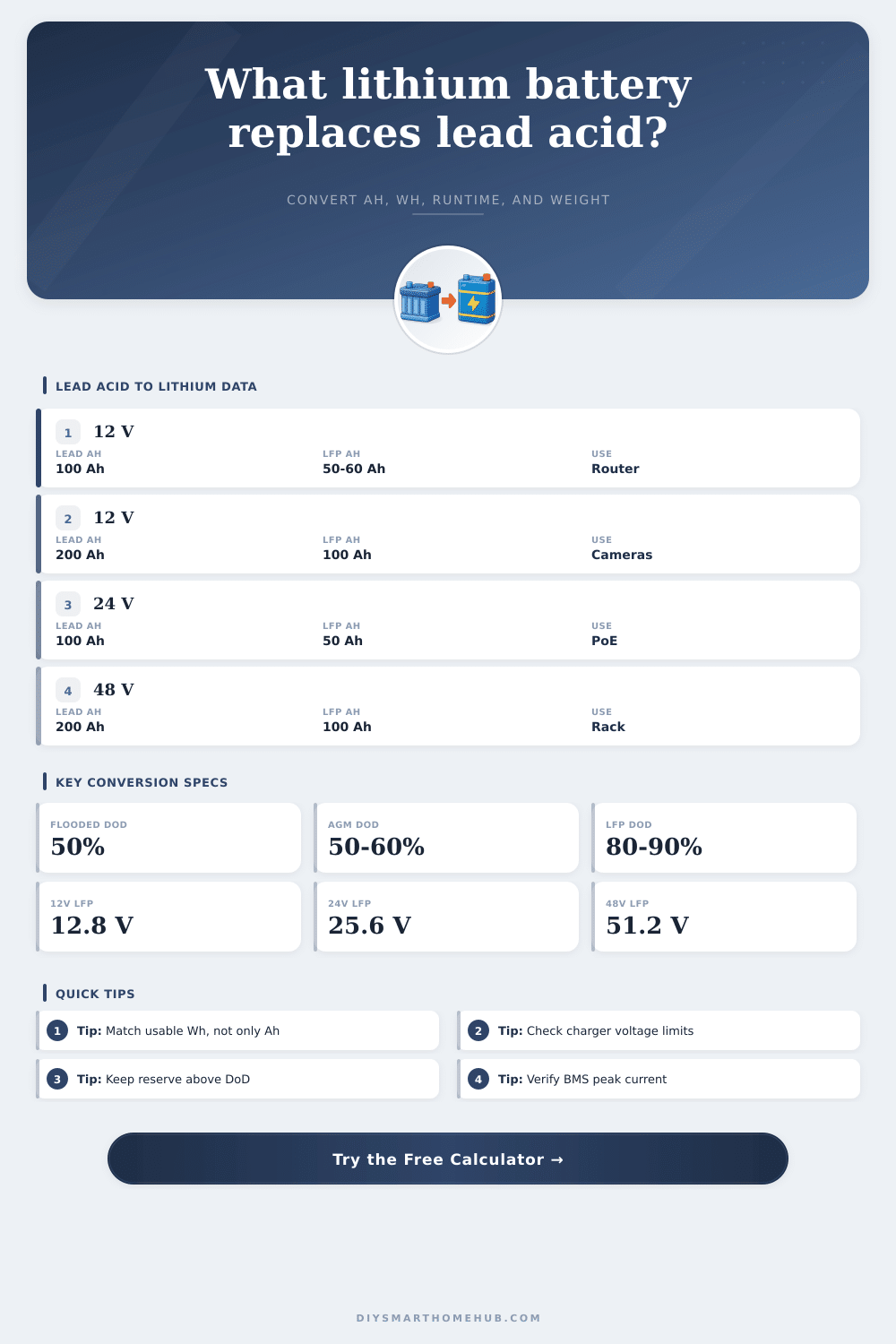
A 100 Ah lead acid bank and a 100 Ah lithium bank are not equivalent in usable energy because their recommended DoD and efficiency differ.
Voltage class must still match
Replace a 12 V lead bank with a 12 V-class lithium pack, such as 12.8 V LFP, unless the charge controller and loads support a different DC bus.
Current limits matter
Lithium packs often hold voltage better under load, but the BMS current rating must cover the peak watts and any inverter startup surge.
| Lead Acid Type | Nominal Usable DoD | Round-Trip Efficiency | Energy Density | Common Smart Home Use |
|---|---|---|---|---|
| Flooded deep cycle | 45-50% | 75-85% | 12-18 Wh/lb | Legacy solar and standby banks |
| AGM deep cycle | 50-60% | 80-90% | 15-22 Wh/lb | UPS, cabinets, camera backup |
| Gel deep cycle | 50% | 80-88% | 14-20 Wh/lb | Low-current standby systems |
| Small sealed SLA | 40-50% | 75-85% | 12-18 Wh/lb | Alarm panels and access control |
| Starter / standby | 20-30% | 75-85% | 15-25 Wh/lb | Short outage backup only |
| Lead carbon | 60-70% | 85-90% | 18-24 Wh/lb | Partial-state solar cycling |
| Lithium Type | Nominal Cell Voltage | Typical Usable DoD | Energy Density | Conversion Note |
|---|---|---|---|---|
| LiFePO4 (LFP) | 3.2 V | 80-90% | 45-70 Wh/lb | Best stationary lead acid replacement |
| Lithium NMC | 3.6 V | 70-85% | 70-110 Wh/lb | Compact high-energy packs |
| Lithium NCA | 3.6 V | 70-85% | 75-115 Wh/lb | Energy dense, needs careful BMS |
| Lithium titanate (LTO) | 2.4 V | 90%+ | 25-45 Wh/lb | High cycle life, lower voltage per cell |
| Lead Acid Bank | Approx Lead Usable | Similar LFP Gross | Typical LFP Ah | Voltage Class |
|---|---|---|---|---|
| 12 V 7 Ah SLA | 34 Wh | 45-55 Wh | 4-5 Ah | 12.8 V |
| 12 V 35 Ah AGM | 170-190 Wh | 220-260 Wh | 18-22 Ah | 12.8 V |
| 12 V 100 Ah AGM | 480-540 Wh | 620-750 Wh | 50-60 Ah | 12.8 V |
| 24 V 100 Ah AGM | 960-1,080 Wh | 1.25-1.5 kWh | 50-60 Ah | 25.6 V |
| 48 V 200 Ah AGM | 3.8-4.3 kWh | 5-6 kWh | 100-120 Ah | 51.2 V |
| Project Scenario | Lead Bank | Average Load | Estimated Runtime | Likely Lithium Start |
|---|---|---|---|---|
| Alarm panel | 12 V 7 Ah SLA | 8 W | 4-5 h | 12.8 V 5 Ah LFP |
| Router shelf | 12 V 35 Ah AGM | 22 W | 7-9 h | 12.8 V 20 Ah LFP |
| PoE camera corner | 12 V 100 Ah AGM | 45 W | 10-12 h | 12.8 V 60 Ah LFP |
| Network rack | 24 V 200 Ah AGM | 180 W | 10-12 h | 25.6 V 120 Ah LFP |
| Home battery cabinet | 48 V 200 Ah AGM | 350 W | 11-13 h | 51.2 V 120 Ah LFP |
A 100 Ah lead acid battery and a 100 Ah lithium battery is not considered to be equivalent batteries because they provide different amounts of usable energy to the equipment that utilize them. Many individuals believes the Amp hour rating of a battery indicates the total amount of energy that the battery contain. The Amp hour rating, however, do not factor in the energy that can be drawn from that battery.
Furthermore, lead acid batteries is fragile and have limitations regarding how deep they can be discharged. If a lead acid battery is ever discharged to 50% of it capacity, the lead acid battery will degrade with time and have a shorter lifespan from which it can derive its energy. In contrast, lithium batteries, spesifically LiFePO4 batteries, can be deeply discharged to 80-90% of their energy before degrading and reducing the lifespan of those batteries.
How Lead Acid and Lithium Batteries Are Different
Because the lead acid batteries degrades with deep discharges, lithium batteries can be more smaller in comparison to lead acid batteries of the same capacity yet still provide the same amount of usable energy. Beyond the capacity of the batteries to provide energy, another factor to consider when comparing lead acid batteries to lithium batteries is the depth of discharge and the round trip efficiency of those batteries. The depth of discharge and round trip efficiency can factor into the amount of energy that can be drawn from the batteries.
Furthermore, another factor to consider is the current state of the lead acid batteries in use. After sitting in use for several years, the lead acid batteries will degrade in their ability to provide one hundred percent of the energy that they was manufactured to provide. Thus, if an individual were to use these specifications to determine the size of a new lithium battery, they may end up with a battery that is too large.
Instead, derating the lead acid batteries will provide an accurate measure of the energy output of those batteries. Another factor to consider in the comparison between lead acid and lithium batteries is that the lithium battery contain a Battery Management System while the lead acid battery do not contain a Battery Management System. The Battery Management System acts as a brain for the battery and protect the battery cells from overcharging and deep discharging of the battery.
The Battery Management System contains a current limit for the battery. If an amount of current is drawn from the battery that comes in excess of that limit, such as a power surge in the equipment using the battery, the Battery Management System will shut off the power to the batteries to protect them. Thus, the peak watts of the devices that the battery is to power must be checked against the current limit of the Battery Management System to ensure that the system will not crash due to an overdraw of the current by the equipment.
Another factor to consider is the weight of the batteries. The weight of the lead acid batteries will be very heavy due to the elements of the battery, lead. In contrast, the lithium batteries will be much lighter.
This factor is important to consider in locations such as high shelves or remote enclosures in which the batteries will be installed. Because the batteries will be much lighter with the use of lithium batteries, this will be a benefit to the installation location of the batteries. Finally, another factor to consider is the type of charger that will be used for the batteries.
The charger that is used with lead acid batteries isnt to be used for the charging of lithium batteries. The lead acid battery chargers contains a high voltage equalization stage. This voltage is likely to cause the Battery Management System of the lithium battery to shut off its power and damage its cells.
The charge profiles must be matched to the voltage of the battery. For instance, a twelve volt system can use a twelve point eight volt LFP battery pack. Another example is that a twelve volt lead acid battery will likely require a charger that outputs a voltage of twelve volts while the lithium battery will require a charger that outputs a voltage of twelve point eight volts.
Thus, if these factors is considered, the battery backup system will be ensured to work correctly.