Solar Water Pump Sizing Calculator
Estimate delivery flow, total dynamic head, pump input watts, solar array watts, and daily energy from the actual lift, pipe run, pressure, and sun window.
Solar pump sizing results
| Pump type | Typical head range | Flow character | Best fit |
|---|---|---|---|
| Brushless surface transfer | 10 to 80 ft / 3 to 24 m | Moderate flow, simple DC control | Rain barrels, tanks, garden manifolds |
| Submersible solar well | 40 to 300 ft / 12 to 91 m | Steady lift from wells or sumps | Wells, cisterns, boreholes, remote tanks |
| DC diaphragm pressure | 30 to 140 ft / 9 to 43 m | Lower flow with pressure capability | Sprayers, small cabins, pressure tanks |
| Surface centrifugal | 10 to 120 ft / 3 to 37 m | High flow when suction lift is low | Ponds, tanks, irrigation headers |
| Helical rotor high-head | 80 to 600 ft / 24 to 183 m | Lower flow, strong lift efficiency | Hill tanks, deep wells, long climbs |
| Low-head pond circulation | 3 to 25 ft / 1 to 8 m | High flow at very low head | Pond turnover, filters, shallow waterfalls |
| Inside diameter | Good flow target | Watch point | Practical use |
|---|---|---|---|
| 1/2 in / 13 mm | 0.5 to 1.5 gpm / 2 to 6 L/min | Loss climbs quickly on long runs | Short drip branches and small barrels |
| 3/4 in / 19 mm | 1 to 4 gpm / 4 to 15 L/min | Good small-system default | Raised beds, troughs, small tanks |
| 1 in / 25 mm | 3 to 8 gpm / 11 to 30 L/min | Often reduces panel size on long pipe | Gardens, orchard headers, cabin supply |
| 1 1/4 in / 32 mm | 6 to 14 gpm / 23 to 53 L/min | Better for community or pond flow | Central tanks and low-pressure irrigation |
| 1 1/2 in / 38 mm | 10 to 22 gpm / 38 to 83 L/min | Useful when pipe is hundreds of feet | Pond circulation and larger transfers |
| 2 in / 51 mm | 18 to 40 gpm / 68 to 151 L/min | Low friction, larger fittings | High-flow low-head solar pumping |
| Daily pump energy | 4 sun hours | 5 sun hours | 6 sun hours |
|---|---|---|---|
| 250 Wh/day | 80 to 100 W array | 65 to 85 W array | 55 to 75 W array |
| 500 Wh/day | 160 to 210 W array | 125 to 170 W array | 105 to 145 W array |
| 1,000 Wh/day | 315 to 420 W array | 250 to 335 W array | 210 to 280 W array |
| 2,000 Wh/day | 625 to 835 W array | 500 to 670 W array | 420 to 560 W array |
| Project | Typical daily volume | Typical head | Sizing note |
|---|---|---|---|
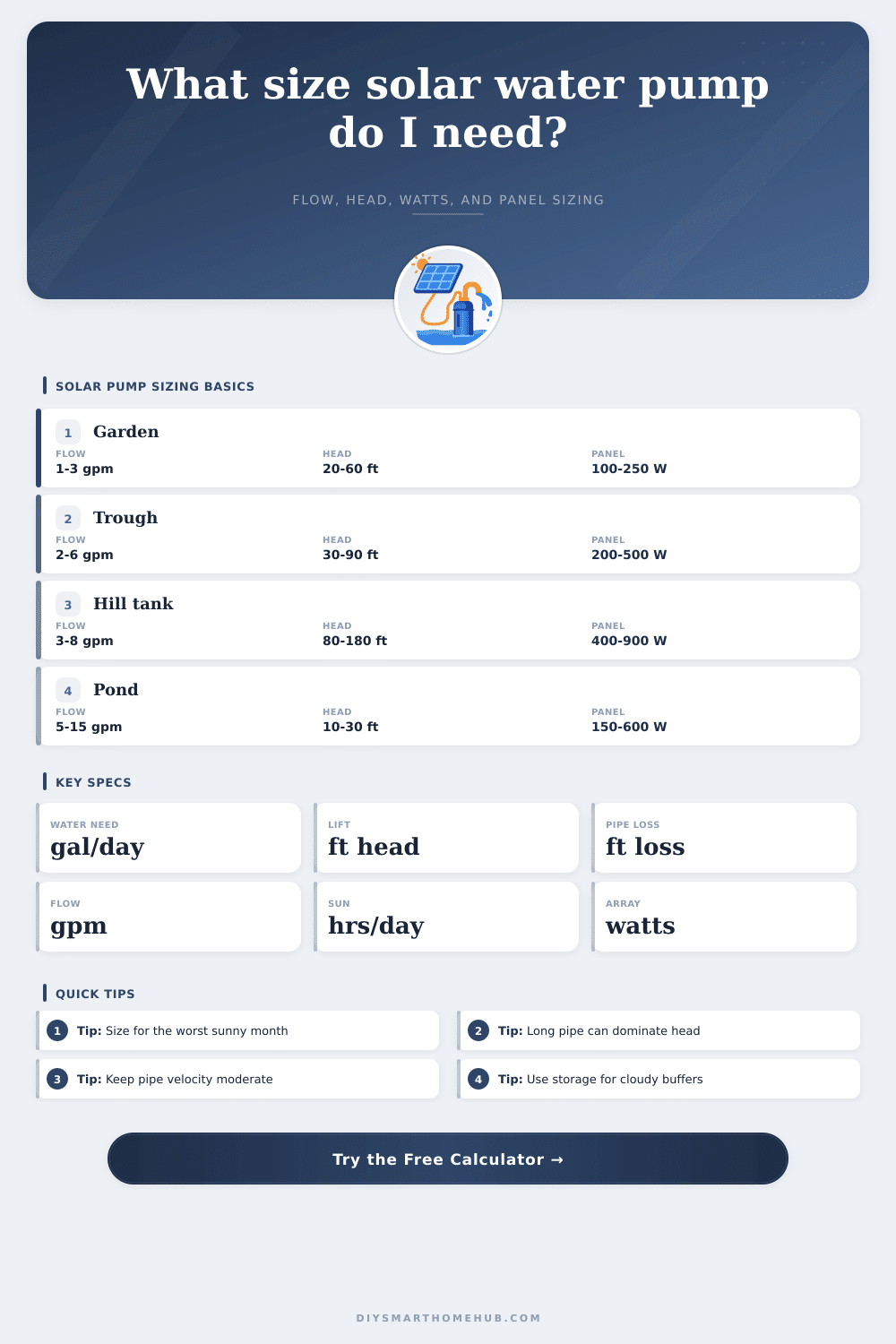
| Patio drip barrel | 20 to 60 gal / 75 to 225 L | 6 to 25 ft / 2 to 8 m | Pressure head can exceed vertical lift |
| Backyard vegetable beds | 150 to 500 gal / 570 to 1,900 L | 20 to 70 ft / 6 to 21 m | Pipe diameter strongly affects head |
| Livestock trough | 200 to 900 gal / 760 to 3,400 L | 30 to 120 ft / 9 to 37 m | Storage volume helps cover cloudy periods |
| Hill tank transfer | 500 to 2,000 gal / 1,900 to 7,600 L | 100 to 300 ft / 30 to 91 m | High-head pump curves matter most |
| Pond circulation | 2,000 to 10,000 gal / 7,600 to 37,900 L | 3 to 25 ft / 1 to 8 m | Use low-head high-flow equipment |
When designing a solar water pumping system, understanding the concept of total dynamic head are essential. Total dynamic head is the total amount of pressure that a pump must overcome to move water from one location to another. Many people assumes that total dynamic head is the vertical lift between the water source and the destination.
However, total dynamic head also takes into account the pressure required at the outlet of the pump and the friction loss of the system. The friction loss of the system result from the rubbing of the water against the inner walls of the pipes. Using long runs of narrow tubing will increase the friction loss of the system.
How to Design a Solar Water Pump System
High friction loss mean that the pump has to work harder to move the water, and high pump requirements mean that there is a loss in the amount of water that can reach the destination of the system. Another critical factor in the design of solar water pumping systems is the diameter of the pipes used. Using a larger diameter for the inside of the pipe will lead to a reduction in friction loss.
Reducing the friction loss of a system will reduce the power requirements for the pump. A person may choose a half inch pipe for the system. A half-inch pipe is relatively inexpensive and easy to install.
However, using a relatively narrow diameter for the pipes in the system will result in high friction loss. High friction loss will restrict the amount of water that can move through the system. If the system does not allow for enough water to reach the destination, the system will not work correct for its intended use.
A calculator can help a designer arrive at the right friction loss and flow rate for the system without having to manually calculating the fluid dynamics of the system. The third factor to consider in the design of solar water pumping systems is the type of pump that will be used. Centrifugal pumps move large volume of water over short distances.
Such pumps are not designed for high vertical lifts. Submersible well pumps are designed to lift water from deep underground wells. However, such pumps are not designed for the movement of large volumes of water over long distances.
Selecting the wrong type of pump for the system according to the terrain requirements will lead to the wasting of solar energy. Additionally, it will damage the pump motor as it will work at capacities beyond what is required of it. Solar energy isnt available consistently for solar water pumping systems.
The availability of solar energy from the sun vary with the time of day and weather conditions. To combat this inconsistency, the solar array should include a design margin. The design margin means adding extra wattage to the solar array.
If the solar panels in an array provide enough energy to the pump to run at peak performance, then cloudy weather will mean that the pump motor will stop rotating. Adding extra wattage to the solar array will ensure that the pump motor continues to run the solar water pump system even when solar energy is not at it’s peak. There are only two main methods for storing the energy produced by the solar array.
These methods is the use of batteries and storage tanks. Using batteries will allow the pump system to work at night when there is no sunlight. However, batteries are expensive and degrade over time.
A storage tank will hold the pumped water and allow it to be release at night into a high tank that can use the force of gravity to dispense water. Using a storage tank allows solar energy to be converted into potential energy that can be used to provide water for the user. Using a sizing tool will reveal two numbers.
These are the input watts for the pump and the suggested wattage for the solar array. The input watts show the power the motor will need to perform the work. The solar array wattage will show how many solar panels the user will have to purchase to account for the inefficiency of the solar pump controller and the variable availability of sunlight.
These two numbers is critical to balancing the cost of the system. Buying too many panels will cost too much money for the user. Buying too few will not supply the power needed to the solar water pump.
Finding the right balance between these two factors will allow the designer to formulate a solar water pumping system that can supply the user with the amount of water they require.