Speaker Cable Loss Calculator
Check how wire gauge, run length, speaker impedance, cable material, and amplifier damping factor change delivered power, attenuation, and control before you pull a long speaker run.
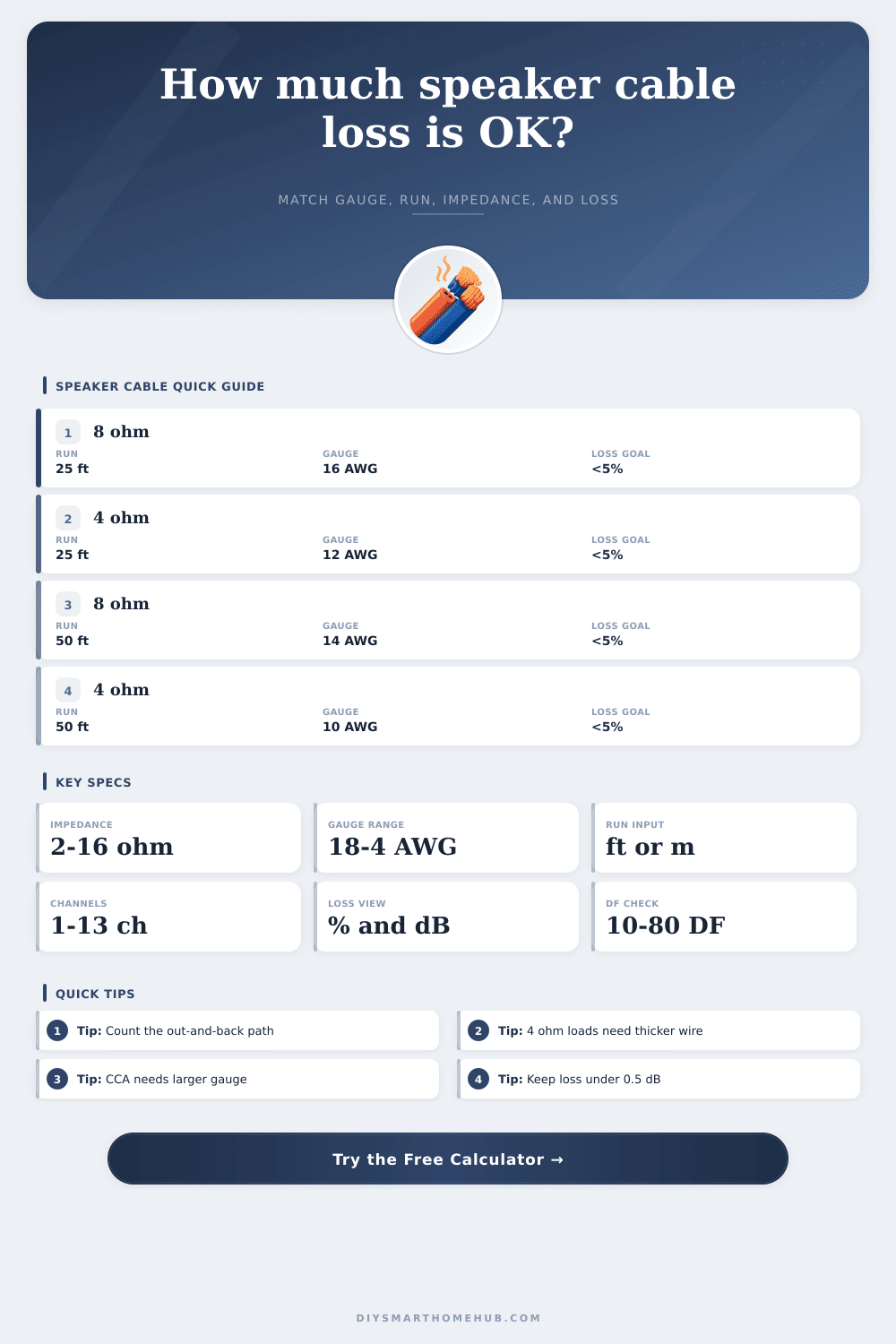
Run length is entered one-way from amplifier to speaker. The math always doubles it for the return conductor, then checks cable-only loss against your target and system damping against the amplifier plus cable resistance.
Calculation Breakdown
| Gauge | Area | Ohms / 1000 ft | Best Fit |
|---|---|---|---|
| 18 AWG | 0.82 mm2 | 6.385 | Desktop speakers, short 8 ohm runs |
| 16 AWG | 1.31 mm2 | 4.016 | Bookshelf stereo in most living rooms |
| 14 AWG | 2.08 mm2 | 2.525 | Longer 8 ohm or medium 4 ohm runs |
| 12 AWG | 3.31 mm2 | 1.588 | Home theater and patio speaker pulls |
| 10 AWG | 5.26 mm2 | 0.999 | Long low-impedance runs and passive subs |
| 8 AWG | 8.37 mm2 | 0.628 | Very long 4 ohm or 2 ohm speaker feeds |
| 6 AWG | 13.30 mm2 | 0.395 | Extreme rack-to-room lengths |
| 4 AWG | 21.10 mm2 | 0.249 | Rare but useful for huge passive loads |
| Loss | Attenuation | Meaning | Typical Takeaway |
|---|---|---|---|
| 2% | About -0.09 dB | Reference-grade | Useful when you want cable nearly invisible |
| 3% | About -0.13 dB | Very conservative | Great for 4 ohm speakers and premium rooms |
| 5% | About -0.22 dB | Common target | Balances wire size and performance well |
| 8% | About -0.36 dB | Noticeable margin | Often acceptable for background zones |
| 10% | About -0.46 dB | Upper practical limit | Usually means step up a gauge if possible |
| Project | Load | Run | Gauge | Why It Works |
|---|---|---|---|---|
| Desktop nearfield | 8 ohm | 8 ft | 18 AWG | Short loop keeps loss very small |
| Bookshelf pair | 8 ohm | 20-25 ft | 16 AWG | Normal stereo runs with easy damping |
| Tower stereo | 4 ohm | 25 ft | 12 AWG | Lower load doubles the effect of cable R |
| Rear surrounds | 6 ohm | 35-40 ft | 14 AWG | Hidden theater runs stay inside 5% loss |
| Outdoor pair | 8 ohm | 60-70 ft | 12 AWG | Long routing needs extra copper margin |
| Passive sub | 4 ohm | 30-50 ft | 10 AWG | Current rises fast with bass-heavy loads |
Speaker cable has an outgoing conductor and a return conductor. A 25 ft amp-to-speaker route is really a 50 ft resistance loop, so underestimating length is the fastest way to undersize a run.
A 4 ohm speaker on CCA cable loses performance much faster than an 8 ohm speaker on copper. If the load is low or the route is long, stepping up one or two gauges is often cleaner than accepting the loss.
When a speaker cables experiences loss, it means that the signal from the amplifier is losing power as it makes its way through the speaker cable. The reason for this loss in power is that the speaker cable has some amounts of resistance to the passage of the signal through it. The resistance of the cable converts some of the electrical energy of the signal to heat energy, meaning that the speaker that receives the signal has less energy from the amplifier than were sent from the amplifier to the speaker cable.
One of the factors that contribute to speaker cable loss is the total length of the speaker cable that is installed. Speaker cables must carry the signal from the amplifier to the speaker, but also carry the signal from the speaker back to the amplifier. The total distance that the signal must travel through the speaker cable is, therefore, twice the distance between the amplifier and speaker.
Why Speaker Cables Lose Power and How to Fix It
For example, if the distance between the amplifier and speaker is 25 feet, the signal must travel 50 feet through the speaker cable. The longer the speaker cable run, the more higher the resistance to the signal. Thus, for long speaker cable runs, it is necessary to use thicker speaker cables to reduce the speaker cable loss between the amplifier and speaker.
Speaker cables that are thicker has a large gauge, and speaker cables that are thicker have less resistance. Another of the factors that contribute to speaker cable loss is the impedance of the speakers that are connected to the amplifier. Because higher impedance loads has more resistance to the passage of current through them than lower impedance loads, an 8-ohm speaker load will offer more resistance to the passage of current through it than a 4-ohm speaker load.
Because the 4-ohm speaker load presents a lower impedance to the signal from the amplifier, more current must travel through the speaker cable to deliver the same amount of power to the speakers. Higher levels of current create a greater impact from the resistance of the speaker cable. Thus, greater speaker cable loss will occur with the 4-ohm speaker load compared to the 8-ohm speaker load.
In order to reduce the loss of power to the 4-ohm speakers, it is necessary to use thicker speaker cables. The material used in the construction of the speaker cables can also impact the resistance of those speaker cables. Copper is the preferred material for speaker cables because copper has a low amount of resistance.
Copper clad aluminum speaker cables contain a different material than copper, but copper clad aluminum has approximately 60 percent higher resistance than copper of the same gauge. Thus, if you use copper clad aluminum speaker cables in an audio system, more power will be lost as the signal travels down those cables due to the higher resistance of copper clad aluminum to the passage of the signal. Additionally, the resistance of the speaker cable also increases with the temperature of the cables.
If the speaker cables are in a warm environment, the resistance of the wires will be higher than if they are in a cooler environment. Damping factor is another measurement of the performance of the system that is affected by the resistance of the speaker cables. The damping factor indicates the ability of the amplifier to control the motion of the woofer of the speaker.
If the addition of resistance from the speaker cables reduces the damping factor, then the amplifier will have less control over the speaker woofer; the bass will sound less controlledly. To avoid this issue, it is necessary for the speaker cables to have a low resistance to ensure that the damping factor remains high. Speaker cable loss can be calculated by determining the impact of loss in either the power output of the amplifier or the decibel levels of the system.
If the amplifier has 100 watts of power, but 5 percent of that power is lost through the speaker cables, the amplifier will only be able to deliver 95 watt to the speakers. The same loss of 5 percent in the power of the amplifier is approximately 0.22 decibels. While this amount of loss in the power of the signal is small, it is possible for these losses to become significant in systems with many channels of speakers and associated speaker cables.
In multi-channel systems, each channel of speakers has its own set of speaker cables. Thus, the number of speaker cables multiplied will result in a significant loss of power to the speakers. When you purchase speaker cables, it is necessary to balance the gauge of the speaker cables against the cost of the cables.
Speaker cables that are thicker (such as 12-gauge speaker wire) have less resistance than speaker cables that are thinner (such as 18-gauge speaker wire). The downside to using thicker speaker cables is that they are more expensive and more difficultly bend through the walls to reach the speakers. For systems that are relatively short in distance (such as a desktop computer and speakers that are only 8 feet apart) and have 8-ohm speakers, 18-gauge speaker wire will have low enough resistance to allow sound to travel efficienty from the speakers to the speakers.
However, for systems that are longer in distance (such as 50 feet) and have 4-ohm speakers, 12-gauge speaker wire should of be used to ensure that the resistance of the speaker cables is minimized and that there is little loss of power to the speakers.