Propane Pool Heater Calculator
Estimate warm-up time, propane burn rate, useful heater output, and tank runtime with pool geometry, weather, and cover assumptions in one planner.
📌Quick Presets
⚙Pool Inputs
Heating Results
Choose a preset or enter your pool details to estimate warm-up time and propane demand.
📊Heater Class Snapshots
Plunge and cocktail pools
About 123k BTU/h useful output and 1.64 gal/h propane draw. Works best for smaller shells or mild shoulder-season lifts.
Balanced residential option
About 210k BTU/h useful output and 2.73 gal/h propane draw. Common match for 12k to 20k gallon backyard pools.
Frequent use and spa assist
About 336k BTU/h useful output and 4.37 gal/h propane draw. Strong choice when quick weekend recovery matters.
Large pools and higher deltas
About 425k BTU/h useful output and 5.46 gal/h propane draw. Useful for big volume, attached spas, or colder startups.
📘Heater Input Comparison
| Heater Class | Useful Output | Propane Draw | Typical Pool Match |
|---|---|---|---|
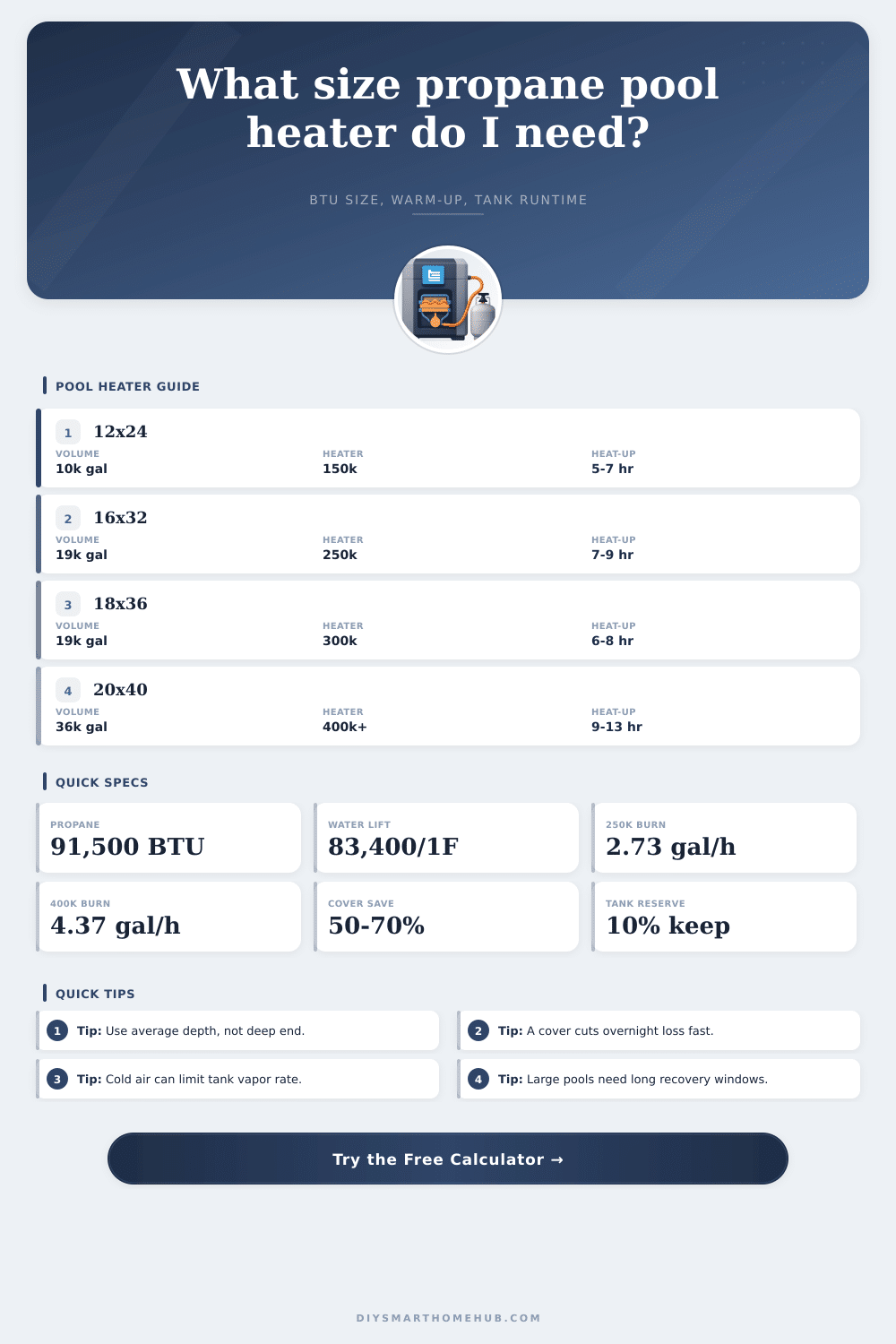
| 150k compact | 123,000 BTU/h | 1.64 gal/h | 6k-10k gal plunge or spool |
| 200k standard | 166,000 BTU/h | 2.19 gal/h | 8k-14k gal small family pool |
| 250k family | 210,000 BTU/h | 2.73 gal/h | 12k-20k gal general residential use |
| 300k extended season | 252,000 BTU/h | 3.28 gal/h | 15k-24k gal cooler weather starts |
| 400k fast recovery | 336,000 BTU/h | 4.37 gal/h | 18k-30k gal frequent swim schedule |
| 500k large format | 425,000 BTU/h | 5.46 gal/h | 28k+ gal or pool plus spa |
Useful output assumes steady-state efficiency from 82% to 85% depending on the selected heater profile.
📏Common Pool Volume Reference
| Pool Layout | Average Depth | Approx Volume | Suggested Heater Class |
|---|---|---|---|
| 12 x 24 rectangle | 4.5 ft | 9,700 gal | 150k to 200k |
| 16 x 32 rectangle | 5.0 ft | 19,150 gal | 250k to 300k |
| 18 x 36 oval | 5.0 ft | 19,050 gal | 250k to 300k |
| 24 ft round | 4.0 ft | 13,540 gal | 200k to 250k |
| 20 x 40 rectangle | 6.0 ft | 35,900 gal | 400k to 500k |
Volume estimates use surface area multiplied by average water depth and 7.48052 gallons per cubic foot.
🌡Temperature Rise Energy Guide
| Pool Volume | 10°F Rise | 15°F Rise | 20°F Rise |
|---|---|---|---|
| 10,000 gal | 834,000 BTU | 1.25M BTU | 1.67M BTU |
| 15,000 gal | 1.25M BTU | 1.88M BTU | 2.50M BTU |
| 20,000 gal | 1.67M BTU | 2.50M BTU | 3.34M BTU |
| 30,000 gal | 2.50M BTU | 3.75M BTU | 5.00M BTU |
Every gallon needs about 8.34 BTU for each 1°F temperature increase, before weather loss and safety buffer are added.
⛽Propane Supply Runtime Guide
| Supply | Usable Gal at 80% Fill / 10% Reserve | 250k Heater Runtime | 400k Heater Runtime |
|---|---|---|---|
| 100 lb cylinder | 16.5 gal | 6.0 hr | 3.8 hr |
| Dual 100 lb cylinders | 33.0 gal | 12.1 hr | 7.6 hr |
| 120 gal tank | 67.2 gal | 24.6 hr | 15.4 hr |
| 250 gal tank | 140.0 gal | 51.3 hr | 32.0 hr |
| 500 gal tank | 280.0 gal | 102.6 hr | 64.1 hr |
Runtime values reflect steady burner input only. Real-world heat-up time can be longer if vaporization, wind, or cold air trims performance.
Cover-first planning: An uncovered pool can lose a large share of its heat overnight. If your runtime looks long, switching the cover strategy usually changes the result faster than a one-step heater bump.
Supply match matters: Pool heaters draw propane fast. A cylinder bank that holds enough fuel may still have poor vapor capacity on cool days, so compare the heater input with the runtime and vapor status together.
Propane pool heaters is tools that are used to increase the temperature of the waters in a pool. Propane pool heaters are efficient in that propane provide a high amount of energy. One gallon of propane produce over 90,000 BTU.
This amount of energy are necessary to heat the water in even the largest pools. The heater’s power should be match to the size of the pool and it’s physical properties. Water can hold heat according to specific measurements.
How to Choose a Propane Pool Heater
It takes eight BTU per gallon of water to heat the water by one degree Fahrenheit. For a 15,000 gallon pool, it takes one million BTU to heat the pool water by one degree Fahrenheit. The water will lose heat to the environment, especially if the pool is exposed to the wind or the night sky.
Therefore, you should choose the propane pool heater with these heat losses in mind. The shape and size of the pool impact the propane pool heater that is used in the pool. The volume of the pool impact the size of an propane pool heater that is necessary to heat the pool.
For instance, a rectangular pool that is 16 feet by 32 feet and five feet deep contains approximately 20,000 gallons of water. A heater that is too small for this volume of water will take a long time to heat the water to the desired temperature. The average depth of the pool is the most important measurement of the pool.
This is the depth of the water that is heated, not the depth of the deep end of the pool. The shape of the pool, such as oval or circular pools, will impact the volume that must be heated. You must calculate the volume of the pool to determine the proper propane pool heater for that pool.
Propane pool heaters come in various sizes. The size of propane pool heaters is measured in BTU. Compact propane pool heaters contains 150,000 BTU.
However, these heaters output only 120,000 BTU. These compact heaters are generally for use in small plunge pools. Medium propane pool heaters has an input of 250,000 BTU and produce 210,000 BTU of output.
These are generally enough to heat residential pools. Large propane pool heaters have an input of at least 400,000 BTU and people use them for heating spas quick or to heat large amounts of water quick. Most propane pool heaters have an efficiency between 82 and 85 percent.
However, if you have a salt pool, you may want to look at models that use cupro-nickel heat exchangers, which is resistant to corrosion from saltwater. Buying propane pool heaters that are too small for your pool will take the heating period from 12 hours to several days. Wind and evaporation will play significant roles in the ability of the propane pool heater to maintain the temperature of your pool.
The faster the pool evaporates, the more heat will be lost. Using a pool cover will limit the amount of heat lost from your pool. Pool covers can limit heat loss by 50 to 70 percent.
Solar blankets and automatic covers is covers that can be used to retain the heat in your pool. Using a pool cover will limit the amount of time that your propane pool heater needs to run. If you do not use a pool cover, your propane pool heater will need to run twice as long to maintain the same water temperature.
The propane fuel needs to be large enough to fuel the propane pool heater. The size of the propane tank will play a significant role in the ability of the propane to vaporize inside the propane pool heater. A propane pool heater with a 250,000 BTU input will burn 2.7 gallon of propane per hour.
Small propane cylinders will struggle to provide enough propane vapor for the propane pool heater to heat the pool effectively when the air temperature is below 70 degrees. Small propane tanks may make the propane pool heater stop working even if there is still propane in the tank. Using a larger propane tank such as a 250-gallon propane tank will allow the propane pool heater to run for several days on a single tank of propane.
Choosing the appropriate size propane tank for your propane pool heater will ensure that the heater does not run out of fuel while heating the pool. To determine if the propane pool heater will work correctly for your pool, you must consider the plumbing and filtration system. You must plumb the propane pool heater correctly to allow the water to circulate correctly around the heater.
You must maintain the filters and pumps correctly to ensure that the propane pool heater does not struggle to heat the pool water. Adding 10 percent extra capacity to the heating plan will allow the heater to handle unexpected weather. Planning for unexpected weather will ensure that the propane pool heater maintains the temperature of your pool when the weather is difficult to deal with.