Electric Baseboard Heater Calculator
Estimate room heating wattage, linear baseboard footage, and branch-circuit load with room shape, ceiling height, climate, and heater-style adjustments.
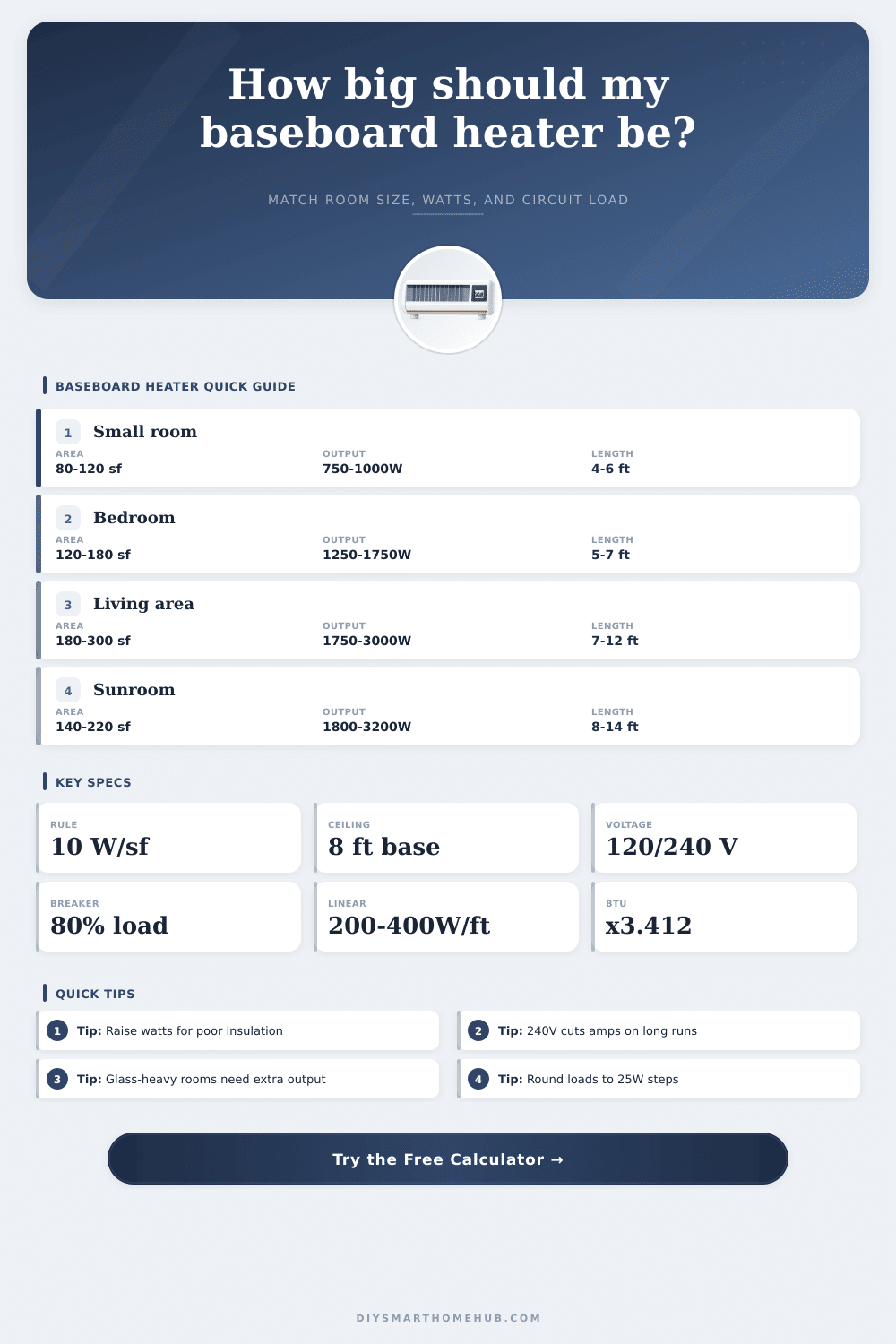
Use room geometry for bedrooms, offices, sunrooms, workshops, and larger open zones. The calculator starts from the common 10 watts per square foot baseline, then adjusts for ceiling height, insulation, climate severity, exposed glass, control strategy, and chosen heater output per linear foot.
Planning snapshot for quick layout checks before you size dedicated heaters or compare 120V and 240V circuit loads.
📌Quick Room Presets
🏠Room And Heater Inputs
Unit System
Calculation Intent
📊Heater Style Specs
📑Heating Load Guide
| Room Condition | Watts per Sq Ft | Watts per Sq M | Planning Note |
|---|---|---|---|
| Tight insulated room, 8 ft ceiling | 8.5-9.5 | 91-102 | Often suitable with smart room control and moderate winter exposure. |
| Average room, standard exterior wall | 10-11 | 108-118 | Common starting point for bedrooms, offices, and family areas. |
| Older home or corner room | 11.5-13 | 124-140 | Extra output helps compensate for leakage and added wall exposure. |
| Large glass area or cold climate zone | 13-15 | 140-161 | Perimeter placement and enough linear footage become more important. |
| Sunroom or severe winter perimeter room | 15-18 | 161-194 | High-output or multiple heater runs may fit the load better. |
🔌Heater Style Comparison
| Heater Style | Output per Foot | Best Room Match | Control / Circuit Note |
|---|---|---|---|
| Standard Fin-Tube | 250 W/ft | Bedrooms, living rooms, hall edges | Easy to split across 240V room thermostats with familiar layout rules. |
| Hydronic Baseboard | 200 W/ft | Quiet rooms, nurseries, offices | Needs more wall length but softens temperature swings in steady-use rooms. |
| Low-Profile Baseboard | 225 W/ft | Remodels with trim or furniture limits | Moderate density when a standard-height cabinet heater will not fit. |
| Fan-Assisted Kick Zone | 400 W/ft | Short wall sections, workshops, entries | Higher amperage per foot, so check branch capacity carefully. |
| High-Output Baseboard | 300 W/ft | Large rooms with limited perimeter | Good compromise between standard layout and compact length. |
| Electronic Panel Baseboard | 275 W/ft | Room-by-room smart zoning | Pairs well with electronic setpoint control where stable sensing matters. |
📋Common Room Size Reference
| Room Example | Heated Area | Target Output | Typical Layout Result |
|---|---|---|---|
| 10 x 12 office | 120 sq ft | 1200-1450 W | About 5-6 ft standard baseboard on 240V. |
| 12 x 14 bedroom | 168 sq ft | 1550-1900 W | About 6-8 ft standard or 5-6 ft high-output. |
| 14 x 16 sunroom | 224 sq ft | 2600-3300 W | Often split into two runs to spread perimeter heat. |
| 18 x 20 living room | 360 sq ft | 3600-4700 W | Two 240V circuits or multi-run layout may be needed. |
| 20 x 20 garage workshop | 400 sq ft | 4200-5400 W | High-output or fan-assisted sections can reduce wall footage. |
🛠Planning Notes
Electric baseboard heat is treated as a continuous load, so this calculator limits usable branch-circuit wattage to 80 percent of breaker rating before estimating how many dedicated circuits are needed.
A 240V heater does not change the room heat requirement, but it does cut amperage in half versus an equal-watt 120V setup, which often simplifies longer heater runs.
Electrical baseboard heaters are broad but short heating element. You install them closest to the floor. It commonly reclines above the baseboard molding or entirely replace it.
Because of that position you call them baseboard heaters. They answer for many various places. In bedrooms, bathrooms, cellars, gateways, kitchens, dining rooms either mid-sized living rooms you can use them.
What Are Electric Baseboard Heaters
Also in offices, meetings, clubs and waiting rooms they well operate.
Those heaters cost relatively little for install and require only a bit ongoing attention. They allow to set the heating temperature apartemanke for every room. The most of the units connect fixed to the domestic wiring.
Some model can differ. You sells them in longs of two until eight feet. Haveblas versions for 120 or 240 volts.
240-volt model works more. They heat chiefly by means of convection. The air-final wrappings heat and circulate the air.
King, done in United States, spread heat by means of convection in his baseboard heaters, so you receive reliable, almost silently comfort. The 903-series is the most kompakteta heater on the market, but it however bids high output and reliability.
Ĉia electrical resistance heat work in 100 percentages. Everything electricity, that it consumes, becomes heat. None varmoperdo happen, because everything goes in the room.
Even so electricity usually costs more than gas. Like this baseboard heat can be quite a lot dear in usage comparitively to natural gas. The easy expenses depend of the warmeco in the rooms, the exterior cold and whether you turn the thermostat overnight or when you are not home.
For them exist programitaj thermostats. Are utile have thermostat in every room. If yours thermostat misfunkcias, summon authorised electrician for control the wires and substitute it.
Security matters during usage of those heaters. Do not lay flammable objects too near. If unit too warms, materials can fumadi either flare during long hejtcikloj.
Imperfect wiring or overloaded circuits can cause fires or short. Baseboard heaters are safer than gaseous, because they do not issue dangerous karbonmonoksidon. At Lowe’s or Menards you find electrical baseboard heaters.
Also on-line you can buy them with free delivery for apt products.