Indirect Water Heater Sizing Calculator
Estimate the right indirect storage tank by combining peak mixed-water demand, usable hot storage, and how much of your boiler can recover the tank during the busiest draw window.
📋Preset scenarios
Each preset loads a realistic indirect water heater situation, then runs the sizing math so you can compare smaller tanks, higher-output coils, and domestic-priority boiler setups quickly.
🔧Indirect sizing inputs
The calculator sizes to mixed gallons delivered at the fixture temperature. It converts boiler recovery into hot gallons at storage temperature, then compares that to the stored hot water your indirect tank can actually deliver.
Indirect sizing summary
Run the calculator to compare required storage, boiler recovery, and how your selected indirect tank covers the busiest draw window.
Calculation breakdown
📦Indirect device and coil profile grid
These profile bands are built into the calculator so the storage recommendation reflects realistic drawdown efficiency and heat-exchanger capture rather than nominal tank gallons alone.
📊Reference tables
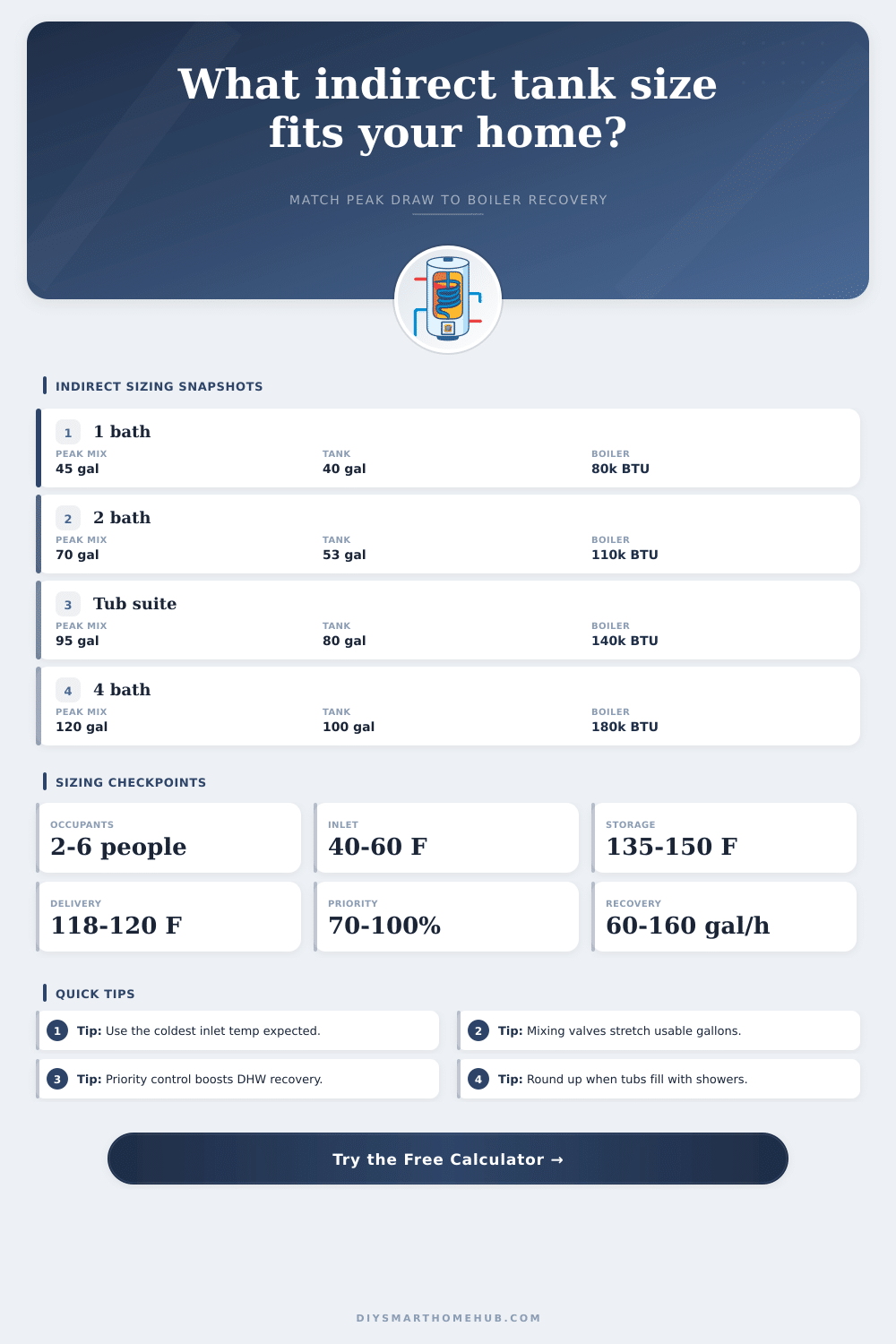
Use the tables below to sanity-check the recommendation against fixture mix, boiler recovery, storage temperature, and common residential indirect sizing targets.
Peak mixed draw guide
| Household | Peak mix | Indirect | Notes |
|---|---|---|---|
| 1 bath condo | 35-45 gal | 40 gal | Single shower with light appliance use |
| 2 bath family | 60-75 gal | 53-60 gal | Two showers plus dishwasher overlap |
| Tub primary suite | 85-100 gal | 70-80 gal | Tub fill added to normal shower demand |
| 4 bath whole home | 110-130 gal | 100-119 gal | Large loads need tank and boiler matched |
Boiler recovery at 145 °F storage
| Net DHW input | Hot gal/h | Mixed gal/h | Typical fit |
|---|---|---|---|
| 70k BTU/h | 74 | 108 | Compact indirect |
| 100k BTU/h | 105 | 153 | 53 gal standard |
| 140k BTU/h | 147 | 214 | 80 gal with tub loads |
| 180k BTU/h | 189 | 275 | 100 gal large family |
Storage temperature mixing benefit
| Storage | Mix factor | 60 gal output | Use case |
|---|---|---|---|
| 130 °F | 1.29 | 77 gal | Lower storage, less lift |
| 140 °F | 1.57 | 94 gal | Common mixed-valve target |
| 145 °F | 1.71 | 103 gal | Strong indirect balance point |
| 150 °F | 1.86 | 112 gal | Higher usable gallons, watch scalding |
Common sizing checkpoints
| Project | Peak load | Tank | Boiler |
|---|---|---|---|
| Starter home | 42 gal | 40 gal | 80-90k |
| Family colonial | 72 gal | 53-60 gal | 100-120k |
| Suite plus tub | 96 gal | 80 gal | 130-150k |
| Large four bath | 120 gal | 100-119 gal | 160-180k |
💡Sizing tips
Size to winter inlet temperature
Indirect tanks look stronger on paper when the inlet water is warm. Use the coldest expected inlet temperature so the mixing multiplier and boiler recovery stay realistic all year.
Check tank volume and boiler share together
A larger indirect tank will not fix a boiler that cannot recover during the draw window. If the margin is negative, compare a larger tank with more domestic priority before choosing either one alone.
Indirect water heater is device that employs heating system of the home for warm water. You know them also as sidearm tanks. They do not depend on own burner but take heat from already existent installation for instance furnace or boiler.
The furnace heats liquid that circulates through coil of heat exchanger in separate water tank. Usually deal about water or mix with antifreeze. The furnace water does not mingle with the water of the tank but only pass through the coils for warm it for domestic use.
How Indirect Water Heaters Work and Why They Save Energy
Base the furnace execute everything during the indirect heater only help heat switch.
Using such tanks you can reach big efficiency. The water in the tank preserves heat so the furnace rarely must light what spares energy. Because the tank keeps the heat like this well it answers for families with high need of warm water and give whirlwind delivery.
If you do not have problems with warm water here change to apt indirect unit probably will provide more warm water no less. Furnaces have usually more than 40000 BTU comparatively to typical direct gas water heater so the coil deliver much more of heat to the domestic water supply.
For such systems exist various variants. For example the PowerStor Series of single wall indirect water heaters have single wall heat exchanger what gives faster heat delivery and water flow. Other models use superb stainless steel for optima heat transfer and long service life of the tank.
Well installed indirect unit can serve 20 until 30 years during electric water heater commonly only 10. They coincide with furnaces of any fuel. That is good solution for those that requires much warm water and use oil for heat.
Well isolated indirect heater can reach almost the efficiency of tankless system while it costs less for installation and attention.