Gas vs Electric Water Heater Calculator
Compare mixed-water demand, actual hot draw, standby losses, recirculation drift, and operating energy so you can test gas tank, tankless, resistance, and heat pump water heater scenarios.
📋Preset Scenarios
Loaded preset: Starter condo resistance with mild inlet water and no recirculation loop.
⚙Calculator Inputs
Enter the blended shower, sink, and appliance water at the tap.
Formula basis: mixed-water draw is converted to actual hot-water draw at the setpoint, then each heater profile adds its own standby load and divides the thermal work by UEF or effective COP.
📊Comparison Results
Run the calculator to see how mixed water, inlet temperature, standby loss, and recirculation change the fuel gap.
No comparison calculated yet.
💻Selected Scenario Spec Grid
Gas standby and electric standby are profile-specific, while recirculation loss is shared thermal work that both heaters must cover.
📑Device and Spec Comparison Grid
📚Reference Tables
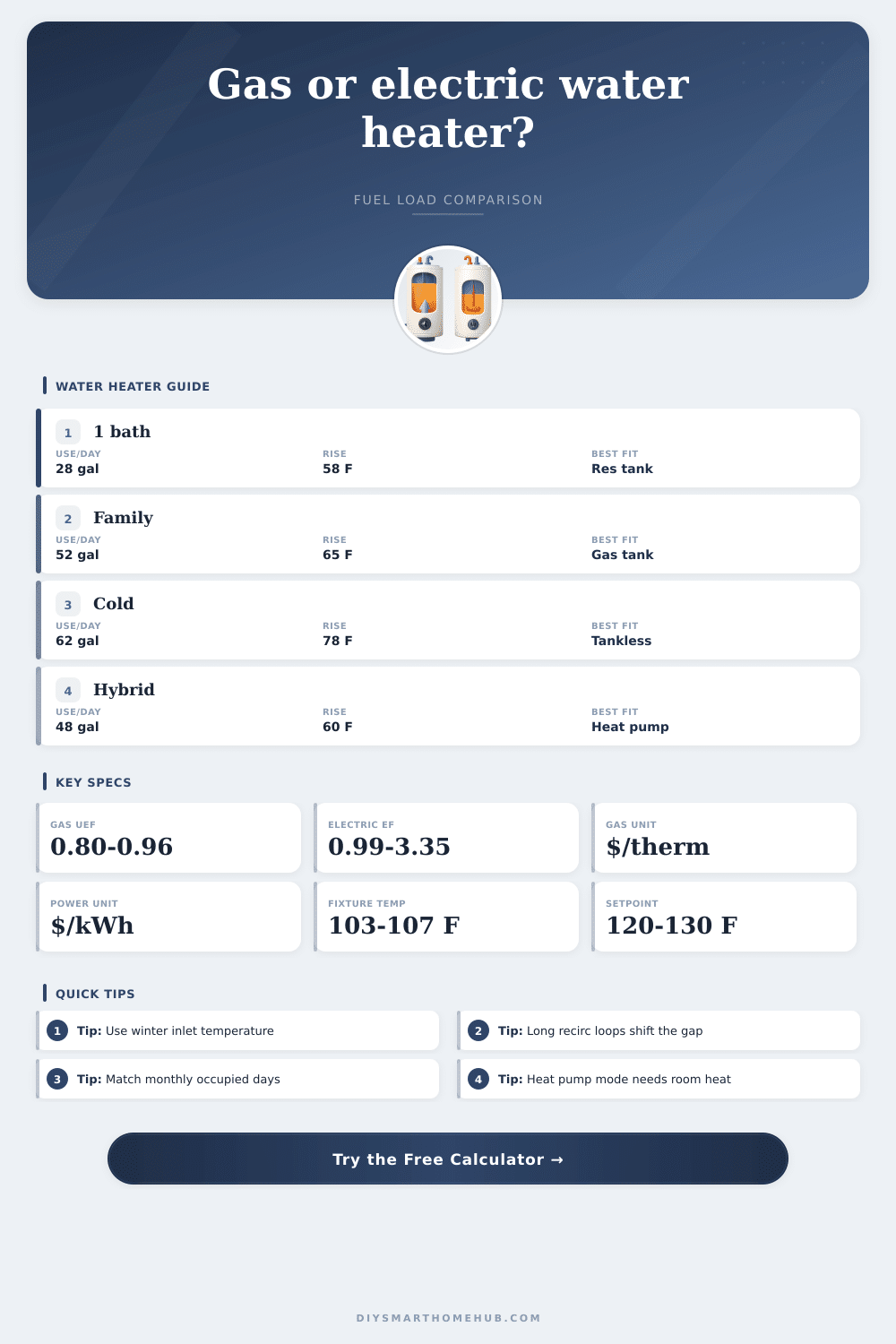
| Scenario | Mixed Use | Typical Rise | Check First |
|---|---|---|---|
| Studio or ADU | 20-32 gal/day | 50-60 F | Resistance tank standby |
| Two-person home | 32-45 gal/day | 55-65 F | Fuel rate spread |
| Family of four | 45-62 gal/day | 60-72 F | Morning recovery |
| Large active home | 62-85 gal/day | 65-80 F | Tankless or hybrid mode |
| Cold Inlet | Fixture Temp | Setpoint | Hot Fraction |
|---|---|---|---|
| 62 F | 104 F | 122 F | 67% |
| 55 F | 105 F | 125 F | 71% |
| 48 F | 106 F | 126 F | 74% |
| 42 F | 107 F | 128 F | 76% |
| Profile | Factor | Standby Day | Best Use |
|---|---|---|---|
| Atmospheric gas | 0.81 UEF | 4200 BTU | Simple retrofit |
| Power-vent gas | 0.88 UEF | 3400 BTU | Tighter envelopes |
| Condensing tankless | 0.96 UEF | 450 BTU | High daily draw |
| Hybrid heat pump | 2.55-3.35 | 650-980 BTU | Moderate electric rates |
| Project Type | Gas Result | Electric Result | Likely Winner |
|---|---|---|---|
| Mild climate condo | 0.18-0.24 therm/day | 4.0-5.5 kWh/day | Rate dependent |
| Busy family home | 0.34-0.48 therm/day | 8.5-12 kWh/day | Gas or hybrid |
| Cold inlet remodel | 0.42-0.58 therm/day | 10-15 kWh/day | Condensing gas |
| Garage hybrid swap | 0.30-0.40 therm/day | 3.2-5.4 kWh/day | Hybrid if room heat stays mild |
🛠Practical Tip Boxes
Tip Box 1
Use the coldest inlet month. Gas and electric water heaters both look better on paper when inlet water is warm. Winter inlet temperature is the safest planning number.
Tip Box 2
Do not ignore loop runtime. A recirculation schedule can add enough thermal loss to erase a small fuel advantage, especially when a tank stays hot all day.
Gas and electric water heaters work by means of different ways. Electric models heat water by means of electrical resistors in their circuits. Gas devices light burner by means of natural gas or propane.
Electric versions usually are silent entirely, because they do not have burner nor vent. At gas one commonly sees pilot flame or light, and maybe hear tiny noise of the burner. Some electric water heaters reach around 98-percent efficiency, because they almost entirely change input energy in heat.
Which Is Better: Gas or Electric Water Heaters
Gas models work in 80 until 85 percentages, but they heat water very quickly.
When you choose between them, tankless gas water heaters fame because of higher efficiency and constant supply of warm water. That does them commonly more cost-effective than electric tankless versions. In many regions gas costs less than electricity.
If you want on-demand system here, where gas is less expensive, choose it. Electric on-demand model can cost more and require additional electrical work. Rather, if electricity is cheaper than gas, electric water heaters you favor.
Some use heat pump electric tanks, that is more saving than average electric water heaters. Those heat pumps are very efficient and good to the surroundings compared with gas.
Many new devices, especially in RVs, are double: gas and electric. They operate by means of propane either 120-volt electricity. The gas setting commonly heats more quickly than the electric.
Even you can use both at the same time for faster warming. Combine them help to get warm water soon in the first use or after shower and dishwashing. If the electric part stays switched, it keeps the water warm and save propane.
If propane ends, the electric aspect continuously operates. Usually is switch for electricity on the device self, and another for gas beside the trailer or control panel. Some models use DSI, that automatically lights the water heaters without matches.
Tankless models give continuous warm water. Compact electric mini-tank heaters quickly provide heat to separate taps, what shortens expectations and save water. Although gas heats more quickly, electric devices more well change energy in heat.