🔊 Decibel to Watt Converter
Convert dBW and dBm to watts and milliwatts for smart home audio, WiFi, Zigbee, Z-Wave, and RF IoT devices.
📊 Conversion Results
| dBW | dBm | Watts | Milliwatts | Example Device |
|---|---|---|---|---|
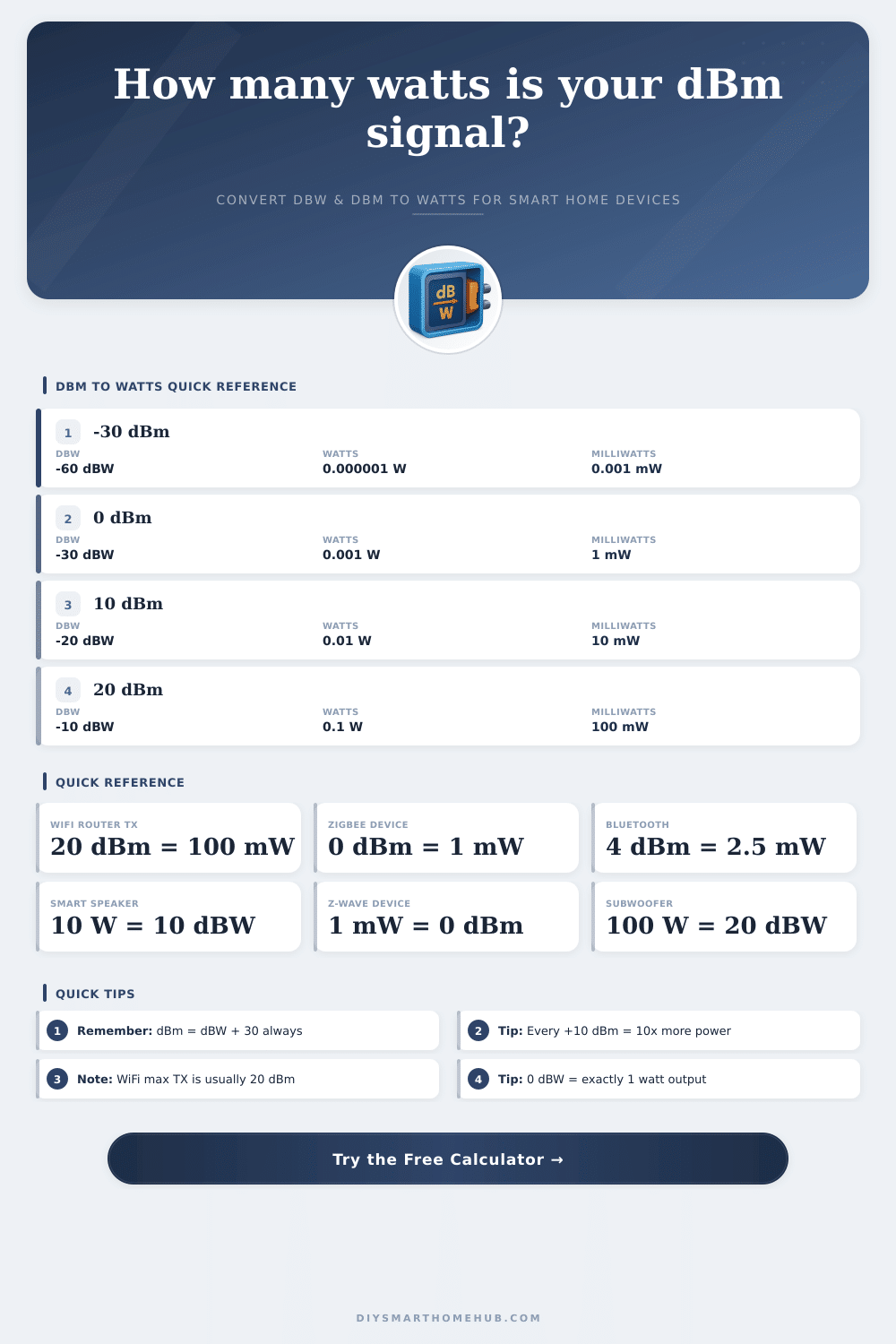
| -30 dBW | 0 dBm | 0.001 W | 1 mW | Zigbee node |
| -20 dBW | 10 dBm | 0.01 W | 10 mW | Z-Wave device |
| -10 dBW | 20 dBm | 0.1 W | 100 mW | WiFi router |
| 0 dBW | 30 dBm | 1 W | 1,000 mW | Small amplifier |
| 5 dBW | 35 dBm | 3.16 W | 3,162 mW | Mini amp |
| 10 dBW | 40 dBm | 10 W | 10,000 mW | Smart speaker |
| 20 dBW | 50 dBm | 100 W | 100,000 mW | Subwoofer |
| 30 dBW | 60 dBm | 1,000 W | 1,000,000 mW | PA amplifier |
| 40 dBW | 70 dBm | 10,000 W | 10,000,000 mW | High-power PA |
| -60 dBW | -30 dBm | 0.000001 W | 0.001 mW | Satellite RX signal |
| Protocol | Typical TX Power (dBm) | Typical Range | Power (mW) |
|---|---|---|---|
| WiFi 2.4GHz (802.11n) | 20 dBm | 30–50 m indoor | 100 mW |
| WiFi 5GHz (802.11ac) | 17 dBm | 15–30 m indoor | 50 mW |
| Zigbee (802.15.4) | 0–8 dBm | 10–20 m indoor | 1–6.3 mW |
| Z-Wave (700 series) | 14 dBm | 30–40 m indoor | ~25 mW |
| Bluetooth 5.0 LE | 4–10 dBm | 10–40 m | 2.5–10 mW |
| Thread / Matter | 0–8 dBm | 10–20 m indoor | 1–6.3 mW |
| 433 MHz RF Sensor | 10 dBm | Up to 100 m | 10 mW |
| EnOcean | 3 dBm | 10–30 m | ~2 mW |
A decibel-watt converter is a tool that changes power values between various units, for instance decibel-milliwatts (dBm), decibel-watts (dBW) and watts (W). In the world of RF energy, levels of power range greatly so such converters really help. They let you go from dBm to watts or vice versa, from watts to dBm. Some of them also handle dBW, megawatts and kilowatts.
What exactly does dBm mean? It shows a power level in decibels regarding one milliwatt (1 mW) as a base. Because of the wide scope of power values, optical and signal levels commonly appear on a logarithmic scale by means of dBm.
How to convert between dBm, dBW and watts
Decibels help to compare amounts that differ in orders of magnitude. For radio or audio signals the standard puts 1 milliwatt at 0 dBm.
To convert watts to dBm you use a formula. Power in dBm equals 10 times the logarithm (base 10) of power in watts plus 30. Those 30 decibels come from the fact taht 1 watt equals 1000 milliwatts, and the logarithm of 1000 is 30 dB.
So a dBW value in dBm is always higher by 30. For instance 10 dBm (10 milliwatts) equals -20 dBW (0.01 watts).
Going the other way, to go from dBm to watts, you multiply the result buy 10 to the negative third power, to pass from milliwatts to watts. Here is a practical example. If a wireless signal has 30 dBm, you calculate the watt value by means of those steps.
Power in watts equals 10 raised to (dBW divided by 10). That is how you convert from dBW back to watts.
Most of these converters are very easy to use. You enter power in dBm and click to convert. Or enter watts and click to convert.
Some work on computers, phones and tablets. You can convert watts to dBm and dBW, dBW to watts and dBm, or milliwatts to dBm and dBW. It simply depends on the starting unit.
An important fact is that decibels themselves do not have units. A decibel expresses a power ratio, and because of that it stays unitless. Such calculations for radio and signals become much more simple, whichexplains their wide usage in such tools.