🌡️ Celsius to Kelvin Converter
Instantly convert any Celsius temperature to Kelvin — with Fahrenheit, Rankine & full reference tables
| Celsius (°C) | Kelvin (K) | Fahrenheit (°F) | Rankine (°R) |
|---|---|---|---|
| -273.15 | 0 | -459.67 | 0 |
| -200 | 73.15 | -328 | 131.67 |
| -100 | 173.15 | -148 | 311.67 |
| -40 | 233.15 | -40 | 419.67 |
| -20 | 253.15 | -4 | 455.67 |
| 0 | 273.15 | 32 | 491.67 |
| 10 | 283.15 | 50 | 509.67 |
| 20 | 293.15 | 68 | 527.67 |
| 25 | 298.15 | 77 | 536.67 |
| 37 | 310.15 | 98.6 | 558.27 |
| 100 | 373.15 | 212 | 671.67 |
| 200 | 473.15 | 392 | 851.67 |
| 500 | 773.15 | 932 | 1391.67 |
| 1000 | 1273.15 | 1832 | 2291.67 |
| Conversion | Formula | Example (100°C) | Notes |
|---|---|---|---|
| Celsius → Kelvin | K = °C + 273.15 | 373.15 K | Most common in science |
| Celsius → Fahrenheit | °F = (°C × 9/5) + 32 | 212 °F | Used in the USA |
| Celsius → Rankine | °R = (°C + 273.15) × 9/5 | 671.67 °R | Engineering thermodynamics |
| Kelvin → Celsius | °C = K − 273.15 | — | Reverse conversion |
| Fahrenheit → Kelvin | K = (°F + 459.67) × 5/9 | — | Via absolute offset |
| Rankine → Kelvin | K = °R × 5/9 | — | Both absolute scales |
| Application | Celsius Range | Kelvin Range | Context |
|---|---|---|---|
| Cryogenics | -273 to -150°C | 0.15 – 123 K | Superconductors, LN2 |
| Deep Freeze / Food | -40 to -18°C | 233 – 255 K | Industrial freezing |
| Weather / Climate | -60 to +60°C | 213 – 333 K | Earth surface temps |
| Human Biology | 35 to 42°C | 308 – 315 K | Hypothermia to fever |
| Cooking / Baking | 100 to 260°C | 373 – 533 K | Boiling to oven roast |
| Metal Processing | 660 to 1535°C | 933 – 1808 K | Aluminum to iron |
| Combustion | 800 to 2000°C | 1073 – 2273 K | Flame temperatures |
| Stellar Surfaces | 2727 to 29727°C | 3000 – 30000 K | Red to blue-white stars |
Changing Celsius to Kelvin is between the simplest changes of temperature. One skips any hard math. Simply adding and taking away help to pass between those two scales of heat.
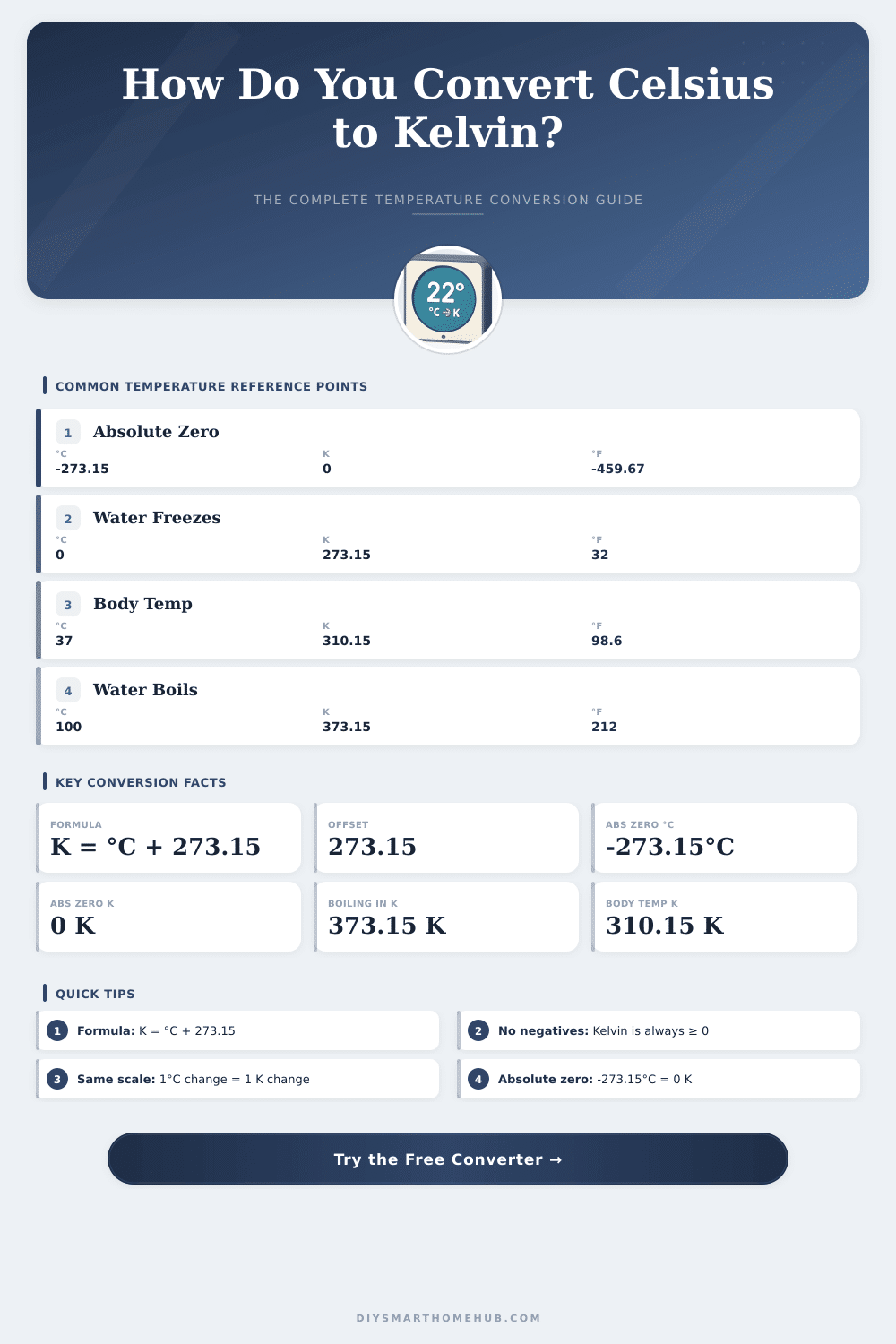
The rule itself is very basic. To pass from Celsius to Kelvin, just add 273.15 to the value in Celsius. The math expression looks like this: K = °C + 273.15.
How to change Celsius to Kelvin
To go the other way, from Kelvin to Celsius, one simply removes 273.15 from the Kelvin number. Then one writes: °C = K, 273.15.
Here some quick examples. Temperature of 0°C matches 273.15 K. If one takes 100°C and converts it, you get 373.15 K. Take now 21°C: it becomes 294.15 K. Also, 1°C matches 274.15 K. Really esay stuff.
The scale of Kelvin is made up of an absolute system for measuring heat, that belongs to the SI. It starts at absolute zero, so 0 K, which is equal to -273.15°C. It marks the moment when all molecular moves halt.
Rather, the Celsius scale starts at the freezing point of water. On Kelvin, the freezing of water happens at 273.15 K, while the boiling point comes at 373.15 K.
One step of the Kelvin scale has same size as won degree Celsius. A rise of 1°C equals a rise of 1 K. Only the place of zero differs. In Kelvin, zero shows absolute cold, not that of water.
Basically, Kelvin simply moves the Celsius zero to absolute cold.
An interesting point about those scales one finds in that Kelvin and Celsius never match in number for actual heat. If one sets them equal, you get 0 = 273.15, which does not have solutions.
Important stuff for understanding energy and heat. Heating something from 10 to 20°C does not double the energy. It only grows it by around 3.5 percent, from 283 K to 293 K. Rather, heating from 10 to 20 K really doubles the energy.
Such a difference plays a big role in scientific studies.
The scale Kelvin is based on energy from heat. It does not relate to anything outside that. Anders Celsius created the Celsius scale, while Lord Kelvin did his.
Also, one does not say “degrees Kelvin“. For 225 K the good expression is “two hundred twenty-five Kelvins”. Celsius uses the symbol for degrees, but Kelvin does not.
Physicists and other experts in science use Kelvin to note very exact values of temperature. When one works with differences between two values of heat, both Celsius and Kelvin work well, becausethe gap between two Kelvin and two Celsius stays the same.