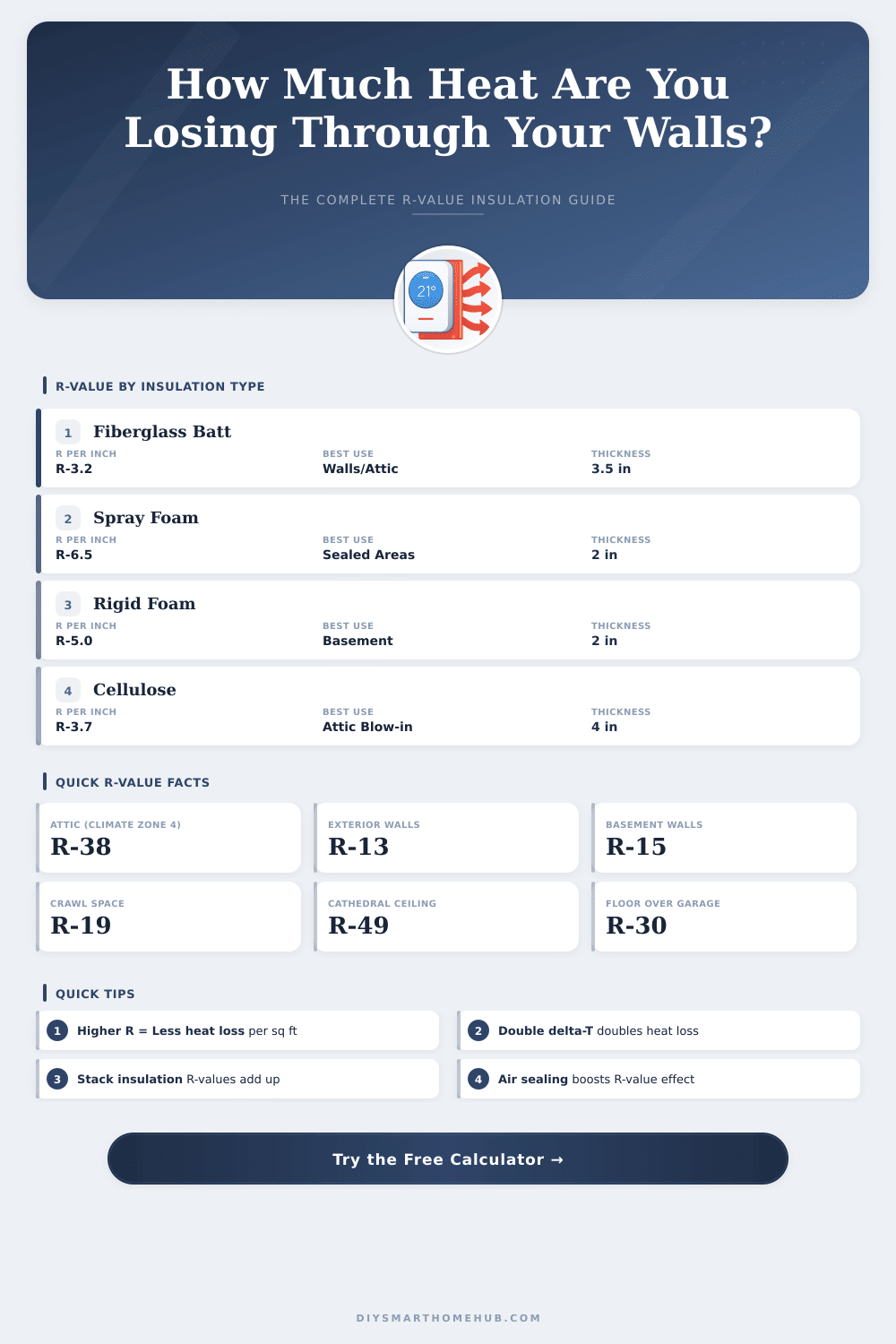
🌡️ Heat Loss Calculator by R-Value
Calculate heat loss through walls, ceilings, and floors using insulation R-values and temperature differences
(per inch)
(per inch)
(per inch)
(per inch)
(per inch)
(per inch)
(per inch)
(per inch)
| Climate Zone | Attic | Exterior Wall | Floor | Basement Wall |
|---|---|---|---|---|
| Zone 1 (Miami) | R-30 | R-13 | R-13 | R-0 |
| Zone 2 (Houston) | R-30 | R-13 | R-13 | R-0 |
| Zone 3 (Atlanta) | R-38 | R-13 | R-19 | R-5 |
| Zone 4 (St. Louis) | R-38 | R-13 to R-21 | R-25 | R-10 |
| Zone 5 (Chicago) | R-49 | R-20 to R-21 | R-30 | R-15 |
| Zone 6 (Minneapolis) | R-49 | R-20 to R-21 | R-30 | R-15 |
| Zone 7 (Duluth) | R-49 | R-21 | R-38 | R-15 |
| Zone 8 (Fairbanks) | R-60 | R-21 | R-38 | R-20 |
| R-Value | ΔT = 30°F | ΔT = 50°F | ΔT = 70°F | BTU/hr per sq ft at ΔT 50°F |
|---|---|---|---|---|
| R-0 (no insulation) | 30.0 | 50.0 | 70.0 | 50.0 |
| R-11 | 2.73 | 4.55 | 6.36 | 4.55 |
| R-13 | 2.31 | 3.85 | 5.38 | 3.85 |
| R-19 | 1.58 | 2.63 | 3.68 | 2.63 |
| R-30 | 1.00 | 1.67 | 2.33 | 1.67 |
| R-38 | 0.79 | 1.32 | 1.84 | 1.32 |
| R-49 | 0.61 | 1.02 | 1.43 | 1.02 |
| R-60 | 0.50 | 0.83 | 1.17 | 0.83 |
| Surface | Typical Area | R-Value | BTU/hr Loss (ΔT=50°F) | Watts Equiv. |
|---|---|---|---|---|
| Attic (ranch house) | 1,200 sq ft | R-38 | 1,579 | 463 W |
| Exterior Walls (2-story) | 1,400 sq ft | R-13 | 5,385 | 1,578 W |
| Floor over crawlspace | 1,000 sq ft | R-19 | 2,632 | 771 W |
| Basement walls | 800 sq ft | R-10 | 4,000 | 1,172 W |
| Single-car garage wall | 400 sq ft | R-13 | 1,538 | 451 W |
Warm perdokalkulilo is in short a tool that estimates how much hejta capacity you truly need to preserve your home warm and pleasant. It works on a simple idea: estimate how much heat flees through walls, floors, ceilings, windows and doors. When it has that cifron then it points how big a hejtsistemon you should install to kompensii those perdajn.
Some of them are available online, and many of them are senpage. One famous version is made specially to estimate domestic hejtobezonojn with good accuracy. Aliuloj work as a basic template, that splits the parts by rooms, walls, windows, roofs, ventilation, everything separate, so that you see where the biggest perdaj happen.
What a Heat Loss Calculator Does
You can even receive monthly energiotaksojn from it. Some calculators follow official rules and allow you to estimate varmoperdon for every separate room, which is useful if you care about more tricky space.
Heat does not flee only through solid walls. Also ventoladaj perdaj are very important. They happen when warm inside air swaps with cold outside air flow.
The calculations for ventolada toll combines the room-volume, the rate of air change, the specific varmokapablon of air and the temperaturnemalon between inside and outside.
For basic calculations of walls or floors it commonly comes down too three parts: the surface-area, the temperature-difference and the R-value (that is the izolaĵa rating). Simply put, the formula is area pomultiĝinta by temperature-difference and divided by R-value. For windows one uses U-value instead, that adds to the mur-calculation and then multiply by the temperature-difference.
Some calculators are done for speciaj uzokazo. For instance to convert kamplan van, here exists a tool that helps to try different izolaĵajn setups. A van with almost nenia insulation has R-value around one, but one loaded with an inch of foam everywhere can reach R-value of five.
If you put those in the numbers, you find values of around 3 kBTU per hour up to even 16 kBTU per hour.
Other types deal with armored heating. Those calculators estimate how much energy you need to varmi the liquid, considering volume, temperatures, specific varmokapablon, density and the time that you must dedicate to that. They also estimate how the hejt-tank truly loses heat, based on its size, izolaĵa thickness, ventrapido and similar factors.
Practical data about brulŝtofo give another way to check your results. If you follow the gas-use during a bit of time and compare it with outside temperatures, you get a real picture. The main point is to use the lowest overnight temperature, not the average, otherwise your hejtsistemo could fail during half of the time.
Simple warning: some calculatorswill not work unless JavaScript is turned on in your browser.