🌍 Carbon Footprint Calculator
Estimate your annual CO₂ emissions from transport, home energy, diet & lifestyle
| Lifestyle / Region | Tonnes CO₂e/Year | lbs CO₂e/Year | vs. Paris 2030 Target |
|---|---|---|---|
| US Average | 16.0 | 35,274 | 8x over target |
| Australia Average | 15.1 | 33,289 | 7.5x over target |
| Canada Average | 14.2 | 31,306 | 7.1x over target |
| EU Average | 6.8 | 14,991 | 3.4x over target |
| UK Average | 5.5 | 12,125 | 2.75x over target |
| China Average | 7.4 | 16,314 | 3.7x over target |
| India Average | 1.9 | 4,189 | Below target |
| Global Average | 4.0 | 8,818 | 2x over target |
| Paris 2030 Target | 2.0 | 4,409 | Target |
| Food Item | kg CO₂e per kg | lbs CO₂e per lb | Relative Impact |
|---|---|---|---|
| Beef (cattle) | 27.0 | 12.2 | 🔴 Very High |
| Lamb / Mutton | 22.8 | 10.3 | 🔴 Very High |
| Cheese | 13.5 | 6.1 | 🟠 High |
| Pork | 10.24 | 4.6 | 🟠 High |
| Farmed Salmon | 7.61 | 3.5 | 🟡 Medium |
| Chicken | 2.42 | 1.1 | 🟡 Medium-Low |
| Eggs | 1.72 | 0.78 | 🟢 Low |
| Rice | 1.21 | 0.55 | 🟢 Low |
| Milk (dairy) | 0.63 | 0.29 | 🟢 Low |
| Lentils | 0.43 | 0.20 | 🟢 Very Low |
| Vegetables (avg) | 0.07 | 0.03 | 🟢 Very Low |
| Tofu | 0.95 | 0.43 | 🟢 Low |
| Transport Mode | kg CO₂e per mile | kg CO₂e per km | Notes |
|---|---|---|---|
| Gasoline Car (avg) | 0.404 | 0.251 | ~25 mpg average |
| Diesel Car | 0.358 | 0.222 | ~28 mpg average |
| Hybrid Car | 0.213 | 0.132 | ~48 mpg average |
| Electric Vehicle | 0.145 | 0.090 | US grid average |
| Short-Haul Flight | 0.255 | 0.158 | Economy class |
| Long-Haul Flight | 0.195 | 0.121 | Economy class |
| Bus (diesel) | 0.089 | 0.055 | Average occupancy |
| Train (electric) | 0.041 | 0.025 | National rail avg |
| Motorbike / Scooter | 0.113 | 0.070 | 125–500cc avg |
The Carbon footprint represents the whole amount of gases with greenhouse effect, that includes Carbon dioxide and methane, that everyday activities generate. It covers the direct and indirect emissions tied to individual, business, product or event through all phases of its lifecycle, since the extract of materials until the usage and production. One commonly uses that word as short way to point the amount of Carbon, usually estimated in tons, that activity or group casts.
Everyday decisions, from roasting of meat in the kitchen until flight for weekend holiday, leave trace on nature. Basically the Carbon footprint helps to simply describe that influence to the ecosystem. Everyone’s footprint ranges according to the place, the habits and the personal choices.
What Is a Carbon Footprint and How We Make It
There exist even online tools for estimating it in three main fields: energy in the home, ways of transportation and waste removal.
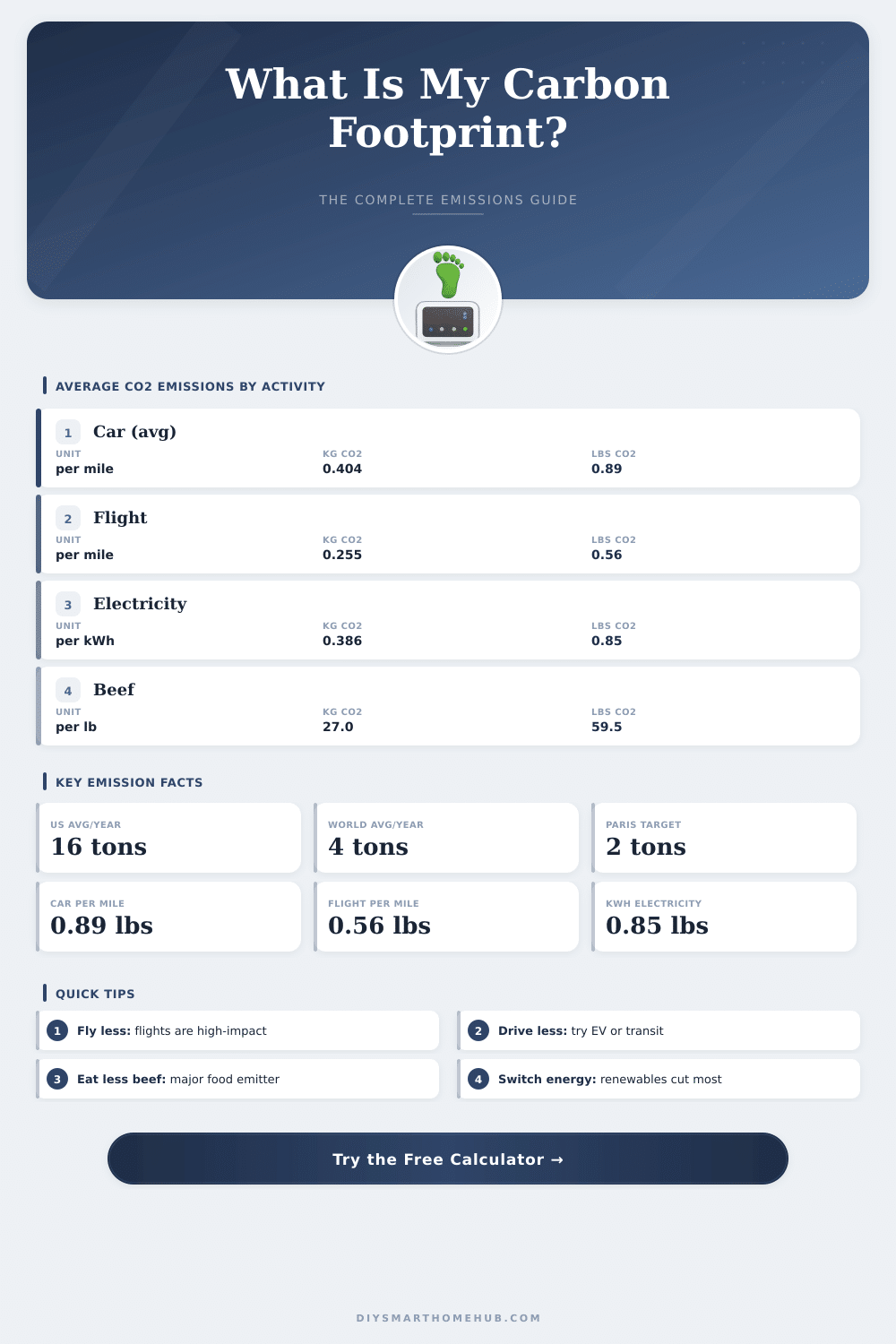
Several gases with greenhouse effect help the change of climate, between them methane, Carbon dioxide and nitrous oxide. Usually one measures the Carbon footprint in match of CO₂. The typical person in United States reaches around 16 tons of CO₂, while the wrold average is only 4 tons. That difference shocks, if one thinks it well.
Daily eating meat causes huge Carbon footprint. Even common video adds it. One hour of streaming on cell generates around 0,56 grams of Carbon, while the same on computer reaches about 10,19 grams.
On 50-inch LED-television, streaming jumps to massive 55,56 grams. Also home working has its footprint. In May 2020, a third of the employees worked from home because of the coronavirus.
Although online working seems better for the surroundings, because trips decrease and copies become rare, it actually expands the digital Carbon issue and brings heavy cost to the ecosystem.
Forests have a central part in the cause. They attract more Carbon from the air then they cast. Globally, forests dump almost the whole half billion tons of Carbon dioxide, that annually gets pulled from the atmosphere.
Even so, forests alone do not solve the climate change. Without fast action, the continuous decline of their absorbing skill could boost the climate change and disconnect the rain cycles, that back water and food security.
RVs form an interesting sample. Four people travelling by means of RV usually have smaller Carbon footprint than flying to the place and using luxury car. Owners of RVs live in 200 until 400 square feet, follow the nice weather and most do not travel too long.
Renting the gear for camping, as tents, instead of buying, also helps to lower the personal footprint. Casual campingtripsters generate only little Carbon issue, although smoking of logs is between the main sources of black Carbon pollution.