💡 LED Lighting Savings Calculator
Calculate your energy savings, watt reduction, and payback period when switching to LED bulbs
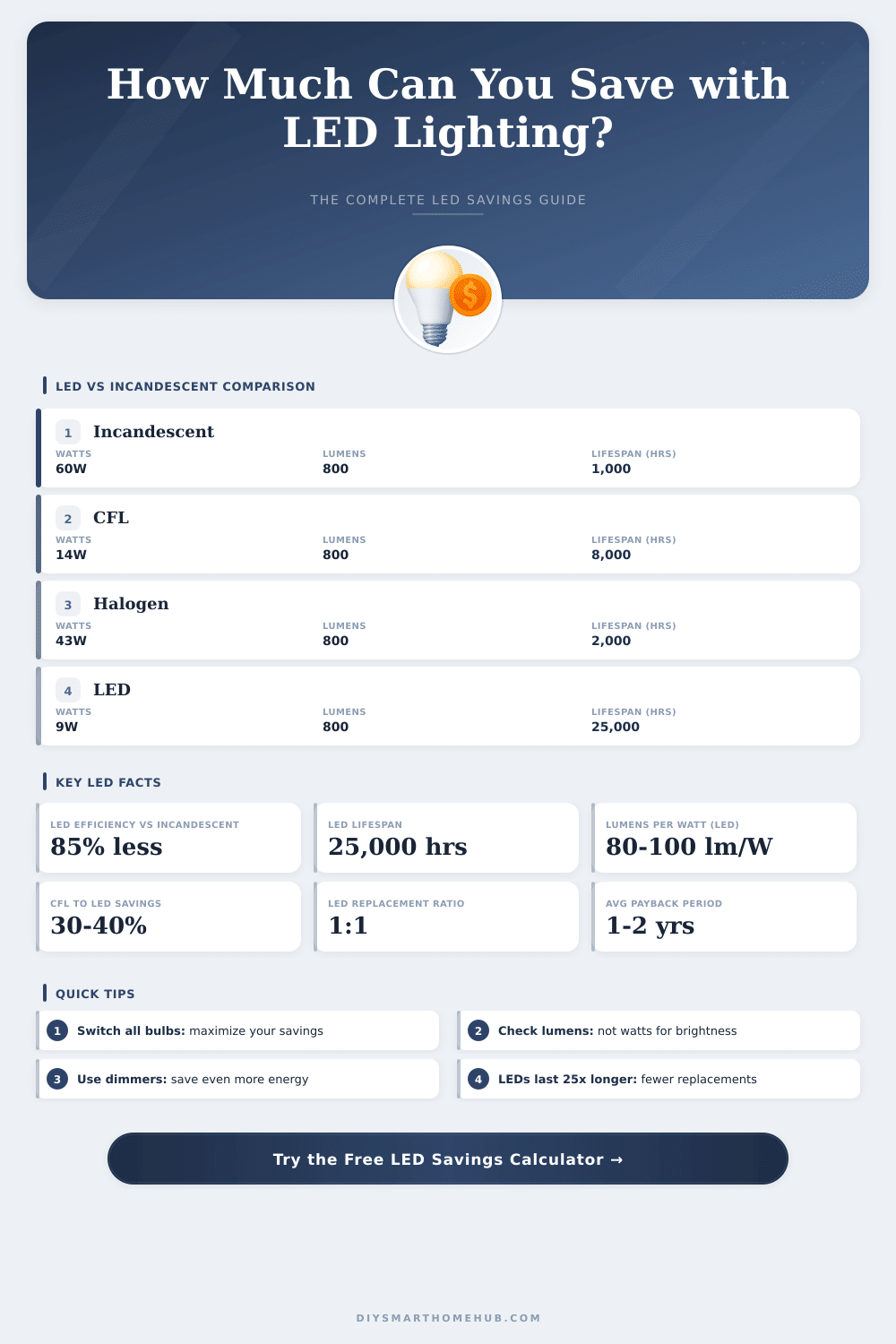
| Bulb Type | Watts (800 lm) | Lifespan (hrs) | Efficacy (lm/W) | Annual kWh* |
|---|---|---|---|---|
| Incandescent | 60W | 1,000 | 13 lm/W | 131 kWh |
| Halogen | 43W | 2,000 | 19 lm/W | 94 kWh |
| CFL | 14W | 8,000 | 57 lm/W | 31 kWh |
| Standard LED | 9W | 15,000 | 89 lm/W | 20 kWh |
| Premium LED | 8W | 25,000 | 100 lm/W | 17 kWh |
| Commercial LED | 6W | 50,000 | 133 lm/W | 13 kWh |
| Old Bulb (Incandescent) | LED Equivalent | Watts Saved | Savings % | Approx. Lumens |
|---|---|---|---|---|
| 25W | 4W LED | 21W | 84% | 250 lm |
| 40W | 6W LED | 34W | 85% | 450 lm |
| 60W | 9W LED | 51W | 85% | 800 lm |
| 75W | 11W LED | 64W | 85% | 1,100 lm |
| 100W | 14W LED | 86W | 86% | 1,600 lm |
| 150W | 20W LED | 130W | 87% | 2,600 lm |
| Room / Zone | Typical Bulbs | Old Watts Total | LED Watts Total | Annual kWh Saved* |
|---|---|---|---|---|
| Bedroom | 4 bulbs | 240W | 36W | 449 kWh |
| Living Room | 8 bulbs | 480W | 72W | 897 kWh |
| Kitchen | 6 bulbs | 360W | 54W | 672 kWh |
| Bathroom | 3 bulbs | 180W | 27W | 336 kWh |
| Home Office | 4 bulbs | 240W | 36W | 449 kWh |
| Garage | 6 bulbs | 360W | 54W | 672 kWh |
| Whole Home (avg) | 30 bulbs | 1,800W | 270W | 3,357 kWh |
When shopping for LEDs, focus on lumens (brightness) not watts (energy use). A 9W LED producing 800 lumens matches a traditional 60W incandescent perfectly. Look for "lumen output" on the packaging.
Your actual daily usage hours have the biggest impact on savings. Lights left on 8 hrs/day use 33% more energy than lights on 6 hrs/day. Install occupancy sensors or timers in low-traffic areas to maximize your LED savings further.
Switching to LED lighting is one of the simplest ways to lower your electric bills. LED lighting uses at least 75 percent less energy compared to regular bulbs. Some sources estimate even higher, claiming that LED lighting uses 90 percent less than regular bulbs.
So, if one swaps a 100-watt regular bulb for a 10-watt LED one spares 90 percent of the energy cost only for that bulb alone.
How LED Lights Save Energy and Money
LED lighting also lasts much longer. They last 15 to 25 times more than regular bulbs. The average useful life of an LED bulb reaches around 20 000 hours.
That results in fewer replacements and fewer hassles over the years.
The starting cost can seem a bit high. LED lighting commonly costs up to 10 tiems more than regular bulbs. Even so, after that first cost, the savings truly add up.
Some folk changed all their 100 ceiling lights at home for seven dollars each and cut their electric bill by almost 150 dollars monthly. Others spent around 150 dollars total and hope to spare 30 to 40 dollars monthly. Some folks spare 40 dollars monthly simply by getting rid of regular bulbs.
Even so not all think that the savings are huge. Some estimate them at only some cents per month, so barely worth thinking about. LED lighting commonly makes only a small part of the whole energy use, and factors like more heavy use or changes in prices can hide the difference in the monthly bills.
LED lighting is safer and brighter. They run quite a lot cooler compared to regular bulbs, which lowers the danger of burns or possible fires. They are made of plastic lenses instead of glass, so they resist breaking much better.
The low warmth is a real advantage, especially in tight places like fixtures in campers, where lenses can bend ore melt because of warm regular bulbs.
Using tools like timers and dimmers together with LED lighting, one can spare even more electricity. Timers automatically turn off the lights when they do not need to be used. For outdoor LED lighting that stays on during long times, LED lighting or compact fluorescent bulbs work very well.
In addition, there are programs and state supports like discounts or tax credits, that help offset the cost of the change.
By 2027, broad use of LED lighting could spare around 348 TWh of electricity. That matches the output of 44 big power plants and tops 30 billion dollars in total savings. Switching to LED lighting also can lower the carbon output of a home by around 500 pounds and spare up to 75 dollars yearly.
For businesses, the yearly savings reach even thousands ofdollars. To estimate your own savings, one compares the old wattage with the new LED watt on a monthly and yearly base, then converts that to kWh using local electric rates.