⚡ DC Wire Gauge Calculator
Find the correct AWG wire size for any 12V, 24V, or 48V DC circuit — based on current, wire length & voltage drop
| AWG | Diameter (in) | Diameter (mm) | Area (mm²) | Resistance (Ω/1000ft) | Max Amps (Open Air) | Max Amps (Chassis) |
|---|---|---|---|---|---|---|
| 4/0 (0000) | 0.460 | 11.68 | 107.2 | 0.0490 | 260 | — |
| 3/0 (000) | 0.410 | 10.40 | 85.0 | 0.0618 | 225 | — |
| 2/0 (00) | 0.365 | 9.27 | 67.4 | 0.0780 | 190 | — |
| 1/0 (0) | 0.325 | 8.25 | 53.5 | 0.0983 | 150 | — |
| 1 AWG | 0.289 | 7.35 | 42.4 | 0.1239 | 130 | — |
| 2 AWG | 0.258 | 6.54 | 33.6 | 0.1563 | 95 | — |
| 4 AWG | 0.204 | 5.19 | 21.2 | 0.2485 | 70 | — |
| 6 AWG | 0.162 | 4.11 | 13.3 | 0.3951 | 55 | — |
| 8 AWG | 0.128 | 3.26 | 8.37 | 0.6282 | 40 | 46 |
| 10 AWG | 0.102 | 2.59 | 5.26 | 0.9989 | 30 | 33 |
| 12 AWG | 0.081 | 2.05 | 3.31 | 1.588 | 20 | 23 |
| 14 AWG | 0.064 | 1.63 | 2.08 | 2.525 | 15 | 17 |
| 16 AWG | 0.051 | 1.29 | 1.31 | 4.016 | 13 | 13 |
| 18 AWG | 0.040 | 1.02 | 0.823 | 6.385 | 10 | 10 |
| 20 AWG | 0.032 | 0.81 | 0.518 | 10.15 | 5 | 7.5 |
| 22 AWG | 0.025 | 0.64 | 0.326 | 16.14 | 3 | 5 |
| AWG | Resistance (Ω/1000ft) | Total Wire (ft) | Voltage Drop (V) | Drop % | Suitable? |
|---|---|---|---|---|---|
| 18 AWG | 6.385 | 20 | 1.277 | 10.6% | ❌ Over limit |
| 16 AWG | 4.016 | 20 | 0.803 | 6.7% | ❌ Over limit |
| 14 AWG | 2.525 | 20 | 0.505 | 4.2% | ⚠️ Marginal |
| 12 AWG | 1.588 | 20 | 0.318 | 2.6% | ✅ Good (3%) |
| 10 AWG | 0.9989 | 20 | 0.200 | 1.7% | ✅ Excellent |
| 8 AWG | 0.6282 | 20 | 0.126 | 1.0% | ✅ Oversized |
| AWG | 5A Load | 10A Load | 15A Load | 20A Load | 30A Load | 50A Load |
|---|---|---|---|---|---|---|
| 18 AWG | 5.6ft | 2.8ft | 1.9ft | — | — | — |
| 16 AWG | 8.9ft | 4.5ft | 3.0ft | — | — | — |
| 14 AWG | 14.1ft | 7.1ft | 4.7ft | 3.5ft | — | — |
| 12 AWG | 22.5ft | 11.3ft | 7.5ft | 5.6ft | — | — |
| 10 AWG | 35.7ft | 17.9ft | 11.9ft | 8.9ft | 6.0ft | — |
| 8 AWG | 56.7ft | 28.4ft | 18.9ft | 14.2ft | 9.5ft | — |
| 6 AWG | 90.1ft | 45.1ft | 30.0ft | 22.5ft | 15.0ft | 9.0ft |
| 4 AWG | 143ft | 71.6ft | 47.7ft | 35.8ft | 23.9ft | 14.3ft |
| 2 AWG | 227ft | 113ft | 75.6ft | 56.7ft | 37.8ft | 22.7ft |
| 1/0 AWG | 360ft | 180ft | 120ft | 90ft | 60ft | 36ft |
Election of the right dc wire rating for circuits in DC matters a lot. If the wire is too thin, it can overheat and even trigger fire. Too thick wire wastes money and commonly does not fit well in the links.
The main idea stays to find that right measure, that ensures safe flow of current without too much loss of voltage along the way.
How to Choose the Right DC Wire Size
In DC systems, two main spots deserve attention. One of them is, does the wire fit to last the flow without overheating. The second relates to voltage drop.
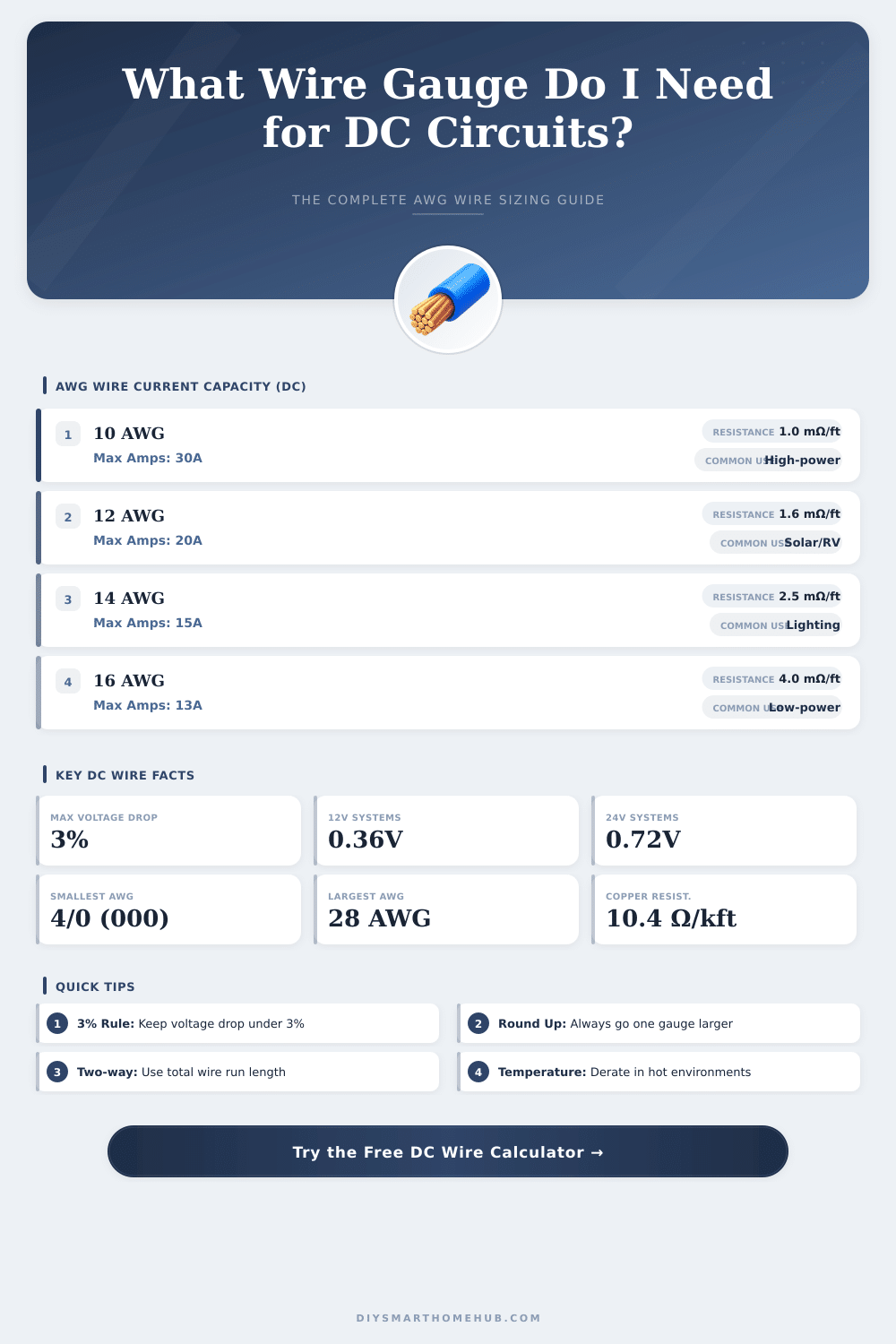
At low values like 12 V, the voltage drop becomes a bigger problem than overheating. This is because even tiny loss in voltage weighs more, when one has only 12 volts for use, rather than 120 volts in typical home AC setup.
Length of dc wire path plays a big role also. In DC circuits the energy flows from battery and back to it, so the real distance doubles. For instance, if the wire runs 5 feet from battery to the device, for math one takes 10 feet.
Long paths require thikc gauge ratings to keep the voltage drop small. A 12-volt heater, that draws 40 amps through 10 gauge wire, can only run about 2.8 feet before losing too much voltage.
Some general tips to help. 10 gauge wire handles 30 amps well. For 20 amps one commonly chooses 12 gauge.
14 gauge wire works for 15 amps. Those values count for AC and DC systems, because amps stay amps and wires are wires.
Solar cables for solar energy usually use 10 or 12 gauge and are rated four around 20 to 30 amps. For bigger setups, like banks of lithium batteries or inverters, you need heavy cables, for instance 2/0 or 4/0, that fit hundreds of amps.
An online calculator for DC dc wire sizes really helps simplify things. It allows you to enter current and voltage data, then compute the right dc wire thickness and cross area. One helpful program, called Circuit Magician, even accepts entry about insulation of wire, temperature rules and other elements.
For low-energy DC setups, it commonly works to choose one dc wire gauge for the whole net. In home AC wiring, where various circuits require different amounts of energy, it is best to choose the smallest fitting gauge for every path. In rural homes one commonly uses 12 gauge or thicker for DC wiring, because such wire reduces energy loss.
Thicker wire is a good way to ensure that every watt arrives to its place. The rule of NEC about 80% also counts, which means that the wire must handle at least 125% of the steady flow through it. Do notspare on DC dc wire gauge ratings.